The Biggest Pokemon Card Price Spikes This Week - 06/04/2026
This week's board is not a modern chase-card rush. It is an exact-variant week led by Skyridge, Prime, Staff promo, Gold Star, and WotC-era cards.
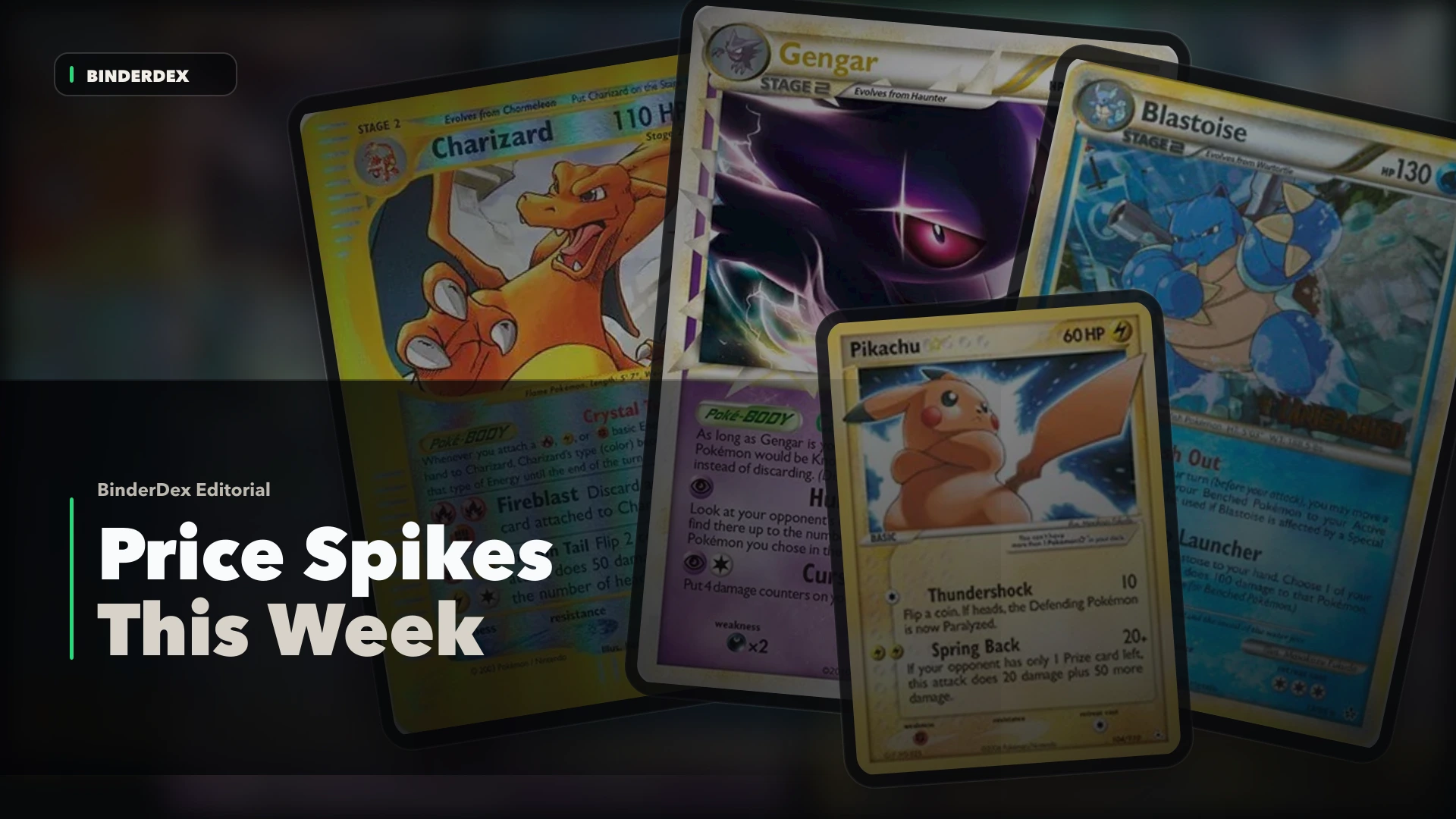
The largest move on the June 4 board is easy to name: Skyridge Charizard, reverse holo, moved from $3,500 to $5,250 in BinderDex Collectr Near Mint data. That is a $1,750 seven-day jump. A normal person reads that and says "rent." A Pokemon collector reads it and asks which Charizard.
That second question matters. This is not a clean "Pokemon is ripping again" week. This is an exact-variant week. Skyridge reverse holos, Prime cards, Staff prerelease stamps, Gold Stars, 1st Edition Neo holos, WotC promos, and e-Card era Eeveelutions are all standing in the same very expensive hallway.
That makes the board useful, but not simple. Scarce cards can move sharply because one clean copy, one repricing event, or one thin lane changes the visible number. Treat this as a watchlist read. Do not sprint to eBay with a cape on.
- The top move is Skyridge Charizard reverse holo at +$1,750 over seven days.
- Vintage and vintage-adjacent variants dominate the board.
- Gengar Prime, Blastoise Staff Prerelease, Pikachu Gold Star, Dark Espeon, and WotC Pokemon Center all moved by more than $300.
- Modern cards are not absent, but the cleanest current-era card here is Latias & Latios GX from Team Up.
- The repeated pattern is not "popular Pokemon good." It is scarcer exact print plus recognizable collector lane.
- Every number below is a BinderDex Collectr Near Mint row checked June 4, 2026.
- This is market-watch framing, not buy, sell, or grading advice.
BinderDex market snapshot
The Price Moves At A Glance
1Charizard
Skyridge · Reverse holo
The chart is huge because this is the exact Crystal Pokemon reverse-holo lane, not a generic Charizard read.
2Gengar Prime
Triumphant · Prime holo
A 100% move on an older Gengar can be real and still thin enough to make a spreadsheet sweat.
3Blastoise Staff Prerelease
HGSS Promos · Staff stamp
The stamp is the chart. Without the Staff lane, this is a completely different conversation.
4Pikachu Gold Star
EX Holon Phantoms · Gold Star
A smaller percentage move, but on a card where even the rounding errors have opinions.
5Dark Espeon
Neo Destiny · 1st Edition holo
Late-WotC, Eeveelution demand, and 1st Edition scarcity are doing the work together.
6Pokemon Center
WotC Promo · Black Star Promo #40
Promo-run collectors do not get many substitutes, which is rude but useful for a chart.
7Espeon
Neo Discovery · 1st Edition holo
A cleaner companion move beside Dark Espeon, with less drama and plenty of demand.
8Articuno
Legendary Collection · Reverse holo
The fireworks reverse pattern is the point. The card brought its own lighting department.
9Espeon H9
Aquapolis · H-number holo
H-number e-Card holos are their own password-protected collector lane.
10Rayquaza
EX Deoxys · Reverse holo
Not the Gold Star, thankfully for everyone's blood pressure, but still a Rayquaza-famous set.
11Lugia EX Team Plasma
Plasma Storm · Full art
Team Plasma identity and gameplay memory give this move more shape than a plain Lugia spike.
12Latias & Latios GX
Team Up · TAG TEAM full art
A famous emotional chase can rise for the week while the monthly chart still tells it to sit down.
These are exact seven-day endpoint charts from the BinderDex Collectr Near Mint snapshot. They show the move that put each card on the board, not a full sales history.
#1 Charizard - Skyridge Reverse Holo
This is the card that walks into the chart wearing a price tag and a fireproof suit. Skyridge Charizard is a Crystal Pokemon, illustrated by Kouki Saitou, and numbered 146/144. When the number is higher than the set count, collectors start breathing differently.
Skyridge is also the end of the English Wizards e-Card road, which gives the set a built-in collector tax. The reverse holo lane adds another layer. You are not comparing every Charizard. You are comparing this Secret Rare, this treatment, this condition window.
The move is $1,750 over seven days, up to $5,250. That number deserves attention. It also deserves restraint. When a scarce exact variant moves this hard, the first read should be supply and condition sensitivity, not a new broad-market rule.
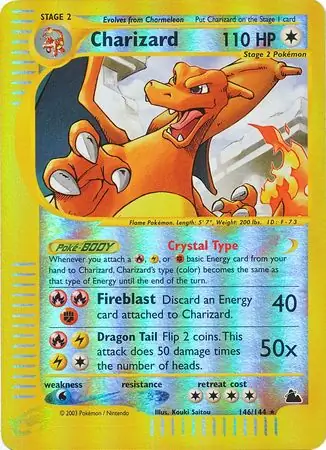
June 4 BinderDex row: Collectr Near Mint reverse holo $5,250, up $1,750 over 7 days. The exact Skyridge reverse-holo lane matters more than the name Charizard by itself.
Price and chart data update with BinderDex · Last refreshed Oct 12, 2026. Editorial commentary reflects the article's published snapshot.
#2 Gengar Prime - Triumphant
Gengar Prime is from Triumphant, the late HeartGold & SoulSilver set, and PkmnCards lists it as a Rare Prime illustrated by Takashi Yamaguchi. It has the old Prime portrait treatment: huge face, metallic border, enough attitude to make a binder page feel supervised.
The gameplay text is part of the charm too. This Gengar cared about the Lost Zone, which means the card has a little "please stop doing things to my hand" history baked into it. Collectors remember mechanics when the art also looks this mean.
The move is bigger than the price history looks comfortable with: $449.23 to $914, up $464.77. That is a 103% seven-day move. I would read this as a thin-lane repricing first and a Gengar-demand signal second.
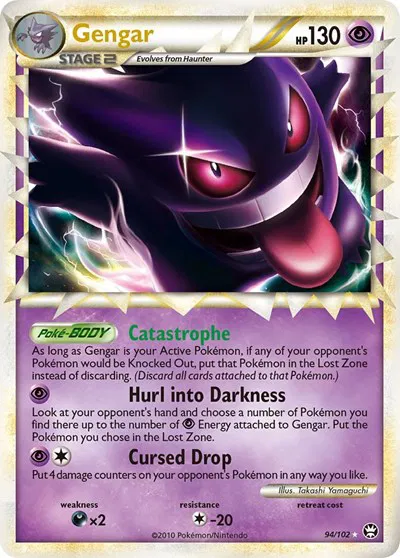
June 4 BinderDex row: Collectr Near Mint holo $914, up $464.77 over 7 days. A large percentage move on an older Gengar variant needs thin-market caution.
Price and chart data update with BinderDex · Last refreshed Oct 12, 2026. Editorial commentary reflects the article's published snapshot.
#3 Blastoise Staff Prerelease - HGSS Promos
This is where the chart gets gloriously nerdy. The underlying card is Blastoise from Unleashed, #13/95, illustrated by Masakazu Fukuda. Bulbapedia notes that Blastoise was the Unleashed prerelease promotional card, and event staff received a specially stamped Staff print.
That stamp is doing a lot of work. A Staff prerelease Blastoise is "Blastoise, but with paperwork" in the best possible collector way: event distribution attached to one of the original big three starters. The audience is smaller, but the people who care tend to care loudly.
The seven-day move is $440, up to $1,500. I would not use it as a read on every HGSS card. I would use it as a reminder that stamps can turn a familiar Pokemon into a completely different market lane.
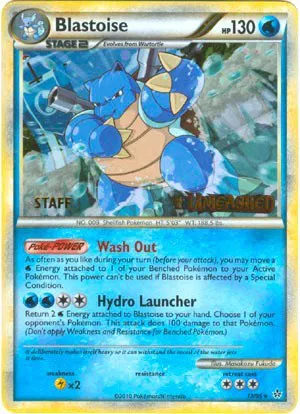
June 4 BinderDex row: Collectr Near Mint holo $1,500, up $440 over 7 days. The Staff Prerelease label is the key variant signal.
Price and chart data update with BinderDex · Last refreshed Oct 12, 2026. Editorial commentary reflects the article's published snapshot.
#4 Pikachu Gold Star - EX Holon Phantoms
Pikachu Gold Star is the least surprising expensive card on this list, which is different from being boring. PkmnCards lists it as Holon Phantoms #104/110, a Rare Holo Star illustrated by Masakazu Fukuda, with the old Pokemon Star deckbuilding rule attached.
That is a ridiculous cocktail: Pikachu, Gold Star, EX era, shiny treatment, 2006 scarcity. If the market had a "fine, I get it" button, this card would wear it out.
That does not make the move clean. The card is already expensive, so a $424.20 seven-day gain to $3,200 is a meaningful dollar move but not a massive percentage move compared with the smaller cards below it. This is a top-card adjustment, not a sleeper waking up.
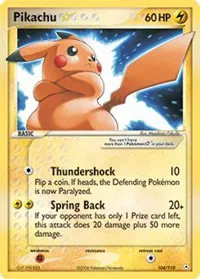
June 4 BinderDex row: Collectr Near Mint holo $3,200, up $424.20 over 7 days. The Gold Star and Pikachu lanes are doing the work together.
Price and chart data update with BinderDex · Last refreshed Oct 11, 2026. Editorial commentary reflects the article's published snapshot.
#5 Dark Espeon - Neo Destiny 1st Edition
Dark Espeon has the exact recipe this week likes: Neo Destiny, 1st Edition holo, Eeveelution demand, and Atsuko Nishida art. The card itself is #4 from Neo Destiny, one of those late-WotC holos that looks soft until you try to find a clean copy.
There is also a personality premium here. Dark Espeon is a moody Eevee-family card from a set built around Light and Dark variants. The market enjoys a theme it can explain in one sentence.
The chart says $369.15 to $765.75, up $396.60. Eeveelution demand matters, but the late-WotC exact print is doing real work too.
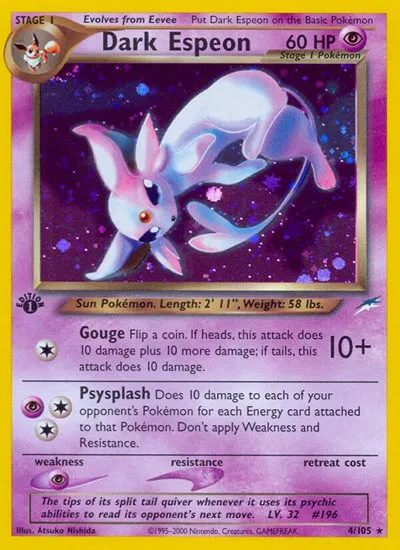
June 4 BinderDex row: Collectr Near Mint 1st Edition holo $765.75, up $396.60 over 7 days. Neo Destiny exact-print context matters here.
Price and chart data update with BinderDex · Last refreshed Oct 11, 2026. Editorial commentary reflects the article's published snapshot.
#6 Pokemon Center - WotC Promo
The Pokemon Center WotC promo is the oddball in the top six, which is why it belongs. Limitless lists it as WotC Promos #40, a Trainer Stadium illustrated by "Big Mama" Tagawa. Bulbapedia ties #40 to the Pokemon Center New York opening on November 16, 2001.
That distribution story matters more than the card text. People building WotC Black Star Promo runs do not have five substitute Pokemon Center promos waiting nearby. If they need #40, they need #40. Annoying for the wallet. Very convenient for the price chart.
At $1,772.07, up $308.83 over seven days, this is not a small card. It is also not a card I would use to make claims about all vintage Trainer promos. The lane is too specific.

June 4 BinderDex row: Collectr Near Mint normal $1,772.07, up $308.83 over 7 days. Promo distribution is the context that makes the card name matter.
Price and chart data update with BinderDex · Last refreshed Oct 11, 2026. Editorial commentary reflects the article's published snapshot.
#7 Espeon - Neo Discovery 1st Edition
This is the second big Espeon lane on the board. Neo Discovery Espeon is cleaner and more direct than Dark Espeon: #1 in the set, Rare Holo, Atsuko Nishida art, and the simple early-Eeveelution pull of seeing Espeon get a spotlight card in 2001.
It is less dramatic than Dark Espeon. That is not a criticism. Sometimes the market does not need a villain arc. Sometimes it just wants a good purple cat with a clean holo window.
The move is $301.01, up to $870. Put next to Dark Espeon, it suggests older Eeveelution exact prints are getting looked at together.
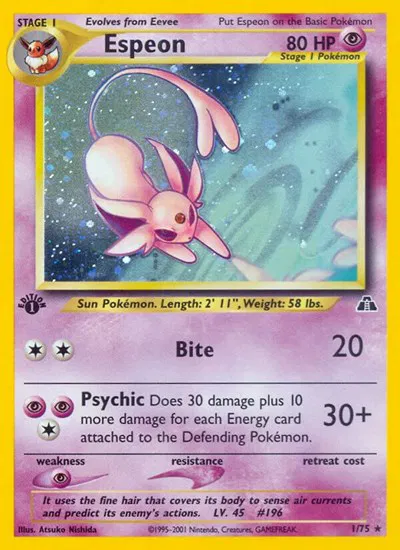
June 4 BinderDex row: Collectr Near Mint 1st Edition holo $870, up $301.01 over 7 days. This pairs naturally with the Dark Espeon move.
Price and chart data update with BinderDex · Last refreshed Oct 12, 2026. Editorial commentary reflects the article's published snapshot.
#8 Articuno - Legendary Collection Reverse Holo
Legendary Collection reverse holos are their own visual world. The fireworks pattern changes even familiar Pokemon into a different collector object, which is a polite way of saying the card looks like it brought its own parade.
The base card is Articuno #2/110, a Rare Holo illustrated by Mitsuhiro Arita. The reverse holo treatment is the important lane here. Legendary Collection is one of those sets where the variant can become more memorable than the underlying checklist slot.
Articuno moved from $184.51 to $472.50, a $287.99 jump. That is a large move for a card whose appeal comes from the treatment as much as the Pokemon.
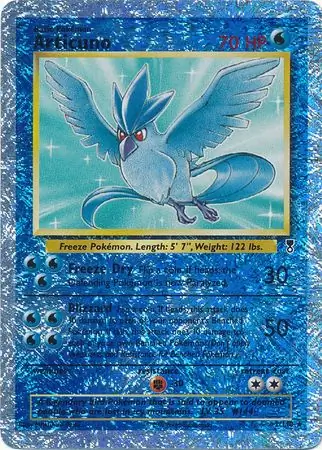
June 4 BinderDex row: Collectr Near Mint reverse holo $472.50, up $287.99 over 7 days. Legendary Collection reverse holo treatment is the lane to watch.
Price and chart data update with BinderDex · Last refreshed Oct 12, 2026. Editorial commentary reflects the article's published snapshot.
#9 Espeon H9 - Aquapolis
Aquapolis sits in the same e-Card neighborhood as Skyridge, and the H-number holos have a clean collector identity. PkmnCards lists Espeon H9 as a Rare Holo from Aquapolis, illustrated by Kyoko Umemoto, released in January 2003.
The H-number matters. It gives the card a collector shorthand. "Espeon H9" sounds less like a card name and more like a password you whisper at a card show before someone opens the expensive binder.
This is the third Eeveelution signal if you count Dark Espeon, Neo Discovery Espeon, and Aquapolis Espeon together. The board is still thin, but the theme is visible.
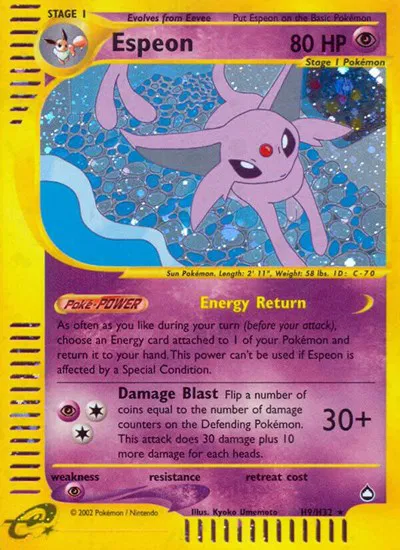
June 4 BinderDex row: Collectr Near Mint holo $720, up $280.75 over 7 days. Aquapolis H-number cards are a different lane from modern full-art demand.
Price and chart data update with BinderDex · Last refreshed Oct 11, 2026. Editorial commentary reflects the article's published snapshot.
#10 Rayquaza - EX Deoxys Reverse Holo
Rayquaza from EX Deoxys shows how character demand and variant demand can stack. PkmnCards lists the base card as Deoxys #22/107, a Rare illustrated by Hiromichi Sugiyama. The BinderDex row is the reverse holo lane.
This is not the Rayquaza Gold Star. That needs to be said before someone kicks the door open. But EX Deoxys is already a Rayquaza-famous set, and that nearby reputation gives the regular reverse holo a better story than it would have in a quieter checklist.
The reverse holo moved to $534, up $216.26. That is a strong enough move to notice, but the better read is nearby context: Rayquaza, EX Deoxys, and reverse-holo condition sensitivity.
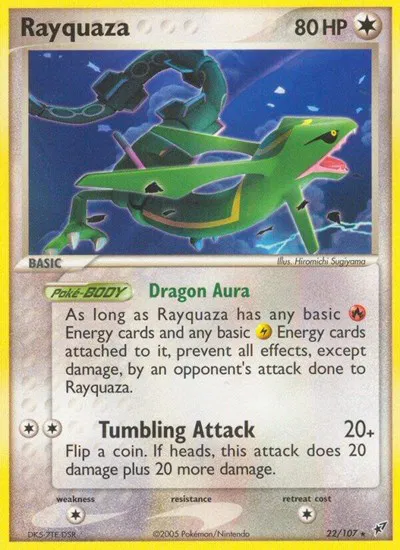
June 4 BinderDex row: Collectr Near Mint reverse holo $534, up $216.26 over 7 days. Read it beside EX Deoxys context, not as a generic Rayquaza comp.
Price and chart data update with BinderDex · Last refreshed Oct 11, 2026. Editorial commentary reflects the article's published snapshot.
#11 Lugia EX Team Plasma - Plasma Storm
Lugia EX Team Plasma is the cleanest Black & White-era card in this group. PkmnCards lists it as Plasma Storm #134/135, an Ultra Rare by Toyste Beach, with Team Plasma branding and the Overflow ability attached.
The card has actual gameplay memory alongside shelf appeal. Lugia taking extra Prizes was the kind of text that made opponents read the card twice and then make a face. That helps the collectible lane because the card had table presence.
The move is $214.25, up to $725. This is not vintage WotC, but it plays the same exact-print game: the Team Plasma full art is the card, not a generic Lugia EX.
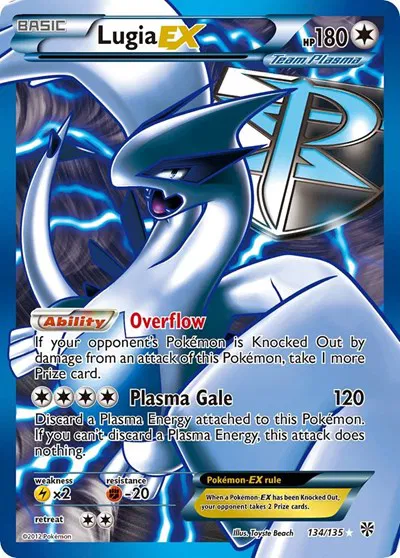
June 4 BinderDex row: Collectr Near Mint holo $725, up $214.25 over 7 days. The Team Plasma full-art identity is the point.
Price and chart data update with BinderDex · Last refreshed Oct 12, 2026. Editorial commentary reflects the article's published snapshot.
#12 Latias & Latios GX - Team Up
Latias & Latios GX is the modern emotional anchor. PkmnCards lists it as Team Up #170/181, an Ultra Rare TAG TEAM illustrated by Sanosuke Sakuma. Collectors know it less as a stat block and more as the card with the heart-shaped composition.
That matters. Some expensive cards are expensive because they are scarce and famous. This one is expensive because it is scarce, famous, and everybody has an opinion about whether it is the sweetest card ever printed or a financial jump scare with wings.
That split is useful. The card can have a positive week without erasing a softer month. For a card this famous, that is the right kind of restraint.
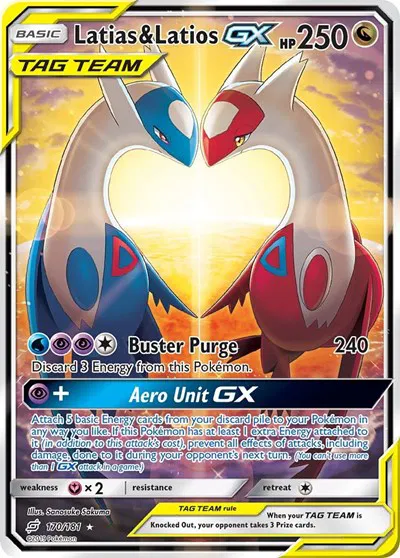
June 4 BinderDex row: Collectr Near Mint holo $2,493.70, up $183.56 over 7 days but down $436.46 over 30 days. Weekly movement and monthly context disagree.
Price and chart data update with BinderDex · Last refreshed Oct 12, 2026. Editorial commentary reflects the article's published snapshot.
Final Read
The June 4 board is loud, but the story is not "everything is running." It is narrower and more useful: scarce variants are repricing in visible ways.
That means the responsible watchlist is exact. Skyridge reverse Charizard is not interchangeable with every Charizard. Gengar Prime is not every Gengar. Staff Blastoise is not every Blastoise. Legendary Collection reverse Articuno is not every Articuno.
If you track anything from this week, track the pattern: high-dollar movement is strongest where the card has a scarce variant identity collectors can name in one sentence. If the explanation takes a paragraph, the market may not be as excited as the chart wants you to be.
For the following checkpoint, compare this board with the June 10 Pokemon card price-spike review. The next snapshot is useful precisely because it shows which moves persisted and which did not.
Know exactly what is in your collection.
Download BinderDex on iPhone or Android to track exact printings, organize your binders, and follow card and sealed product values in one place.
Prefer mobile?