The Biggest Pokemon Card Price Spikes This Week - 05/21/2026
A weekly BinderDex look at the cards moving fastest without turning the watchlist into a hype feed.
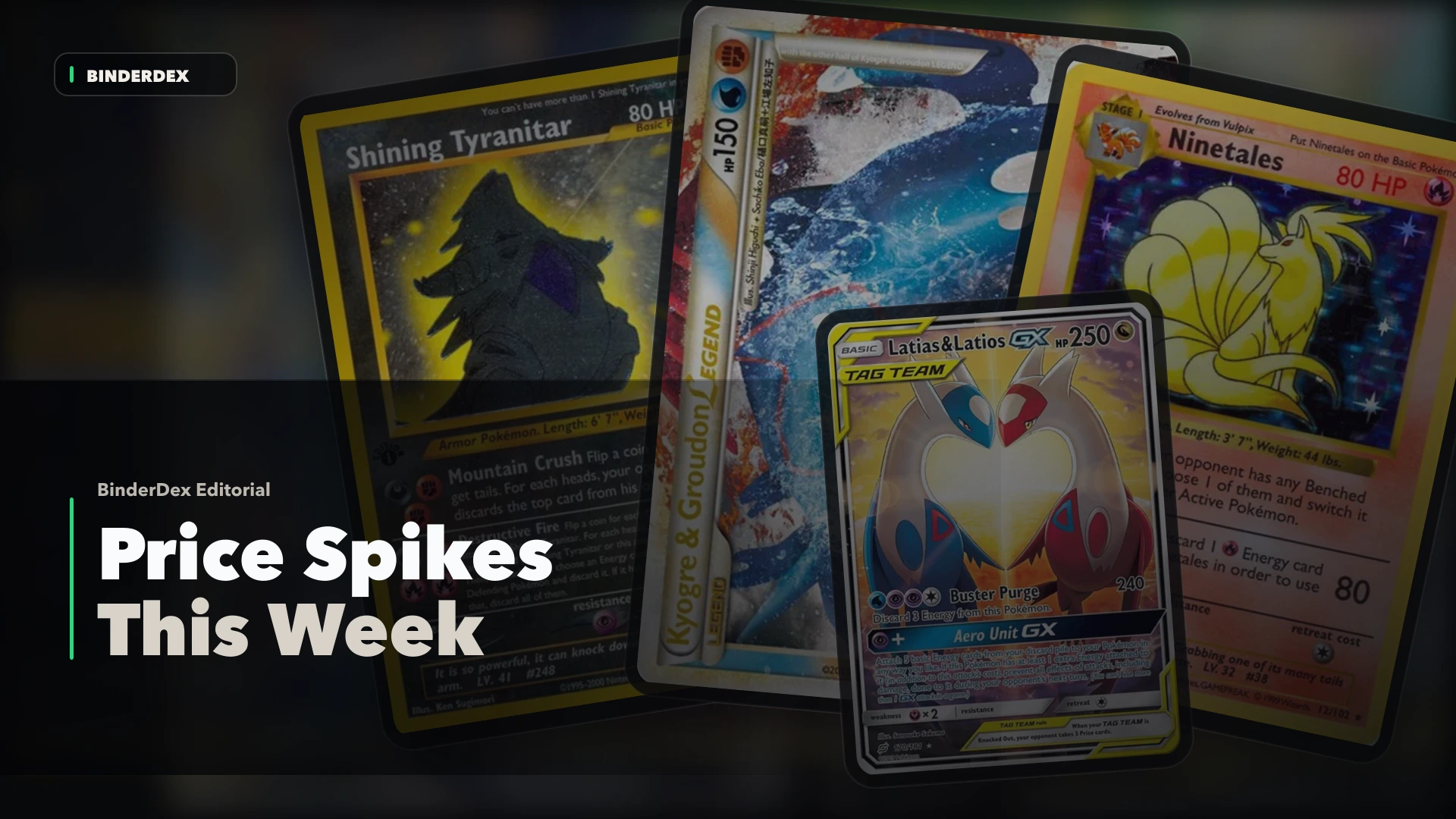
The biggest jump on the board this week is easy to name. Shining Tyranitar moved from $1,539 to $4,250 in BinderDex raw/NM data, a $2,711 seven-day move as of the May 21, 2026 snapshot.
That number is dramatic. It also needs restraint. This is not a modern chase-card week where high volume makes every tick easier to trust. It is a vintage exact-print week. The board is crowded with late Wizards of the Coast holos, e-Card era scarcity, organized-play promos, and one Sun & Moon TAG TEAM icon. Supply, condition, collector memory, and thin-market repricing are all showing up at once.
- Vintage exact prints dominate the board: Neo Destiny, Base Set Shadowless, Legendary Collection, Neo Revelation, Skyridge, and WotC promos all appear.
- The largest dollar move is Shining Tyranitar at +$2,711 over seven days.
- The cleanest modern signal is Latias & Latios GX from Team Up, still one of the defining alternate-art TAG TEAM cards.
- The ranking is raw/NM only. PSA 10, PSA 9, and damaged-copy markets are intentionally not blended into the order.
- Treat this as a market watch, not a chase list.
#1 Shining Tyranitar - Neo Destiny
Shining Tyranitar is the kind of card that can make a weekly mover list look dramatic and still deserve the first look. Neo Destiny sits at the end of the English Neo block, where Light Pokemon, Dark Pokemon, and Shining secret rares all share the same stage. That gives the set a collector identity that is hard to replace: late-WotC nostalgia plus secret-rare scarcity.
The movement here needs a scarcity read before it needs a reaction. A $2,711 raw/NM jump asks whether the market is repricing a genuinely scarce clean copy or reacting to one thin week. Shining Tyranitar is also a Ken Sugimori card, which gives it a different kind of gravity: a WotC-era Shining Pokemon with franchise-lineage art, a secret-rare number, and a condition profile that gets unforgiving fast.
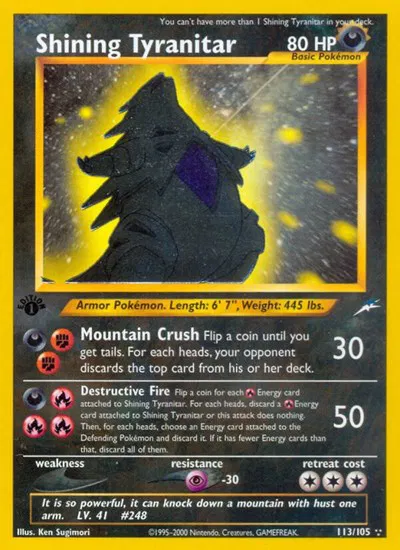
Neo Destiny gives this card the whole late-WotC package: Light and Dark Pokemon in the main set, Shining Pokemon above the set number, and a collector base that cares deeply about exact condition.
Price and chart data update with BinderDex · Last refreshed Oct 11, 2026. Editorial commentary reflects the article's published snapshot.
#2 Kyogre & Groudon Legend (Top) - Undaunted
Kyogre & Groudon Legend (Top) is a reminder that not every high-interest Pokemon card is a traditional single-card chase. Undaunted belongs to the HeartGold & SoulSilver era, when LEGEND cards treated one Pokemon card as a two-card object. That design choice makes the market more fragile. A collector usually wants the top and bottom halves to make the object feel complete.
The seven-day line is blunt: $127 to $499, up $372. The better story is structure. HGSS cards have a different texture from modern illustration rares, with Prime cards and LEGEND halves asking collectors to think in formats that barely exist today. When one half of a Hoenn-duo LEGEND card jumps, the natural follow-up is whether the companion half and nearby LEGEND cards start echoing the move.

Undaunted context matters because LEGEND cards are half-card objects. The top half can move on its own, but collector demand often thinks in pairs.
Price and chart data update with BinderDex · Last refreshed Oct 11, 2026. Editorial commentary reflects the article's published snapshot.
#3 Ninetales - Base Set (1st Edition & Shadowless)
Base Set is the foundation, but this Ninetales is not simply "a Base Set holo." BinderDex labels this print inside the 1st Edition and Shadowless lane, where collectors care about print-run tells as much as the Pokemon itself. Bulbapedia's Base Set overview notes the English set has multiple major variations, including 1st Edition Shadowless and non-1st Shadowless, which is exactly why a clean raw/NM copy can behave differently from a generic Unlimited holo.
The move from $400 to $800 is clean and legible: a classic Base Set holo doubled in the seven-day window. Ninetales does not need to be Charizard to matter here. It has the Base Set halo, early-print scarcity, and a simple visual identity that collectors can recognize instantly.
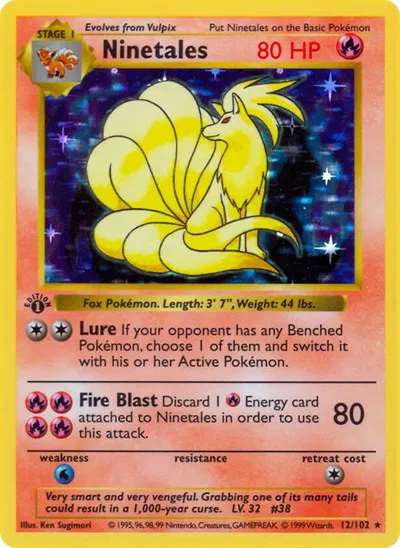
This is an exact-print story. Base Set has multiple English print variations, and the market treats early-print holos differently from later Unlimited copies.
Price and chart data update with BinderDex · Last refreshed Oct 11, 2026. Editorial commentary reflects the article's published snapshot.
#4 Latias & Latios GX (Alternate Full Art) - Team Up
Latias & Latios GX is the modern anchor on an otherwise vintage-heavy board. Team Up introduced TAG TEAM Pokemon-GX in English, and the mechanic changed the shape of Sun & Moon collecting: enormous HP, paired Pokemon, bigger stakes, and alternate arts that felt more like scenes than simple card portraits.
The chart adds $697, from $2,298 to $2,995. A 30% move looks calmer than some of the smaller cards here, but the dollar gain is bigger than many entire card prices on this list. The reason collectors keep coming back to it is obvious from the image: emotional composition, two beloved Pokemon, and a place in the first TAG TEAM expansion. It is one of the few modern cards on this board that can stand next to vintage scarcity without feeling out of place.
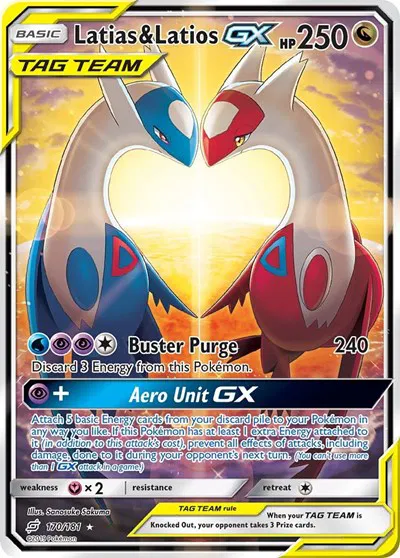
Team Up is the first English TAG TEAM expansion, and this alternate full art remains one of the clearest examples of why that era still commands attention.
Price and chart data update with BinderDex · Last refreshed Oct 12, 2026. Editorial commentary reflects the article's published snapshot.
#5 Squirtle - EX Team Magma vs Team Aqua
Squirtle from EX Team Magma vs Team Aqua is a smaller card with a bigger set story. The 2004 e-Card era was not built around today's full-art chase structure. It was built around theme, factions, and the Ruby/Sapphire conflict between Team Magma and Team Aqua. That makes even ordinary Pokemon feel unusually tied to their expansion.
The move from $113 to $255 is the kind of jump that can happen when a clean copy from a beloved mid-2000s set gets repriced. Squirtle adds another layer: starter Pokemon have broader collector demand than their rarity line implies. A Common Squirtle from an older, personality-rich set can behave more like a character collectible than a set-filler card.
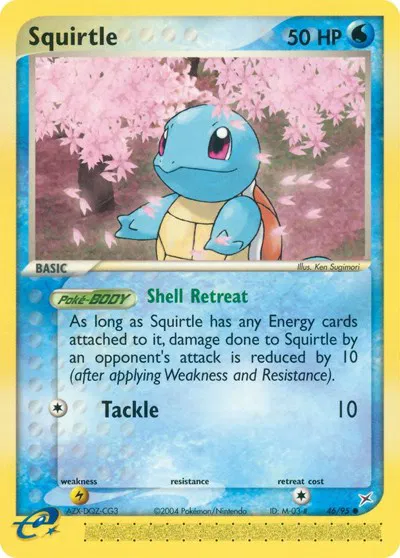
EX Team Magma vs Team Aqua is a faction-themed e-Card era set. Squirtle brings starter demand into a set that already has strong Ruby/Sapphire-era identity.
Price and chart data update with BinderDex · Last refreshed Oct 12, 2026. Editorial commentary reflects the article's published snapshot.
#6 Gumshoos (Staff Prerelease) - Sun & Moon Promo
Gumshoos is the oddest card on the board, which is exactly why it belongs here. Staff prerelease cards are not normal set cards. They sit inside organized-play history: event staff, prerelease distribution, stamped variants, and a smaller pool of people who ever handled the card in the first place.
At the chart level, $14 to $111 looks absurd. That is what tiny baselines do. The right read is not "Gumshoos became a major chase." The right read is that STAFF-stamped prerelease promos can be thin enough that one repricing event changes the chart. This is the least glamorous card on the list, but it may be the best example of why exact variant labels matter.
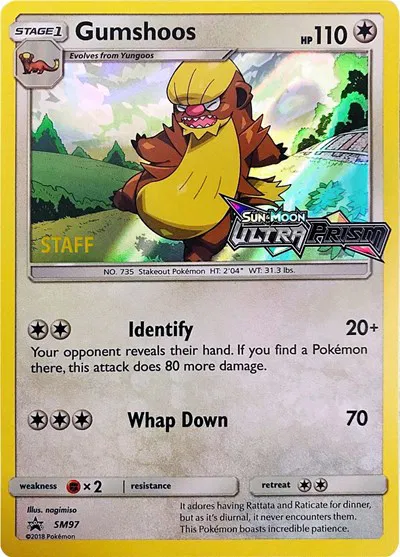
Staff prerelease cards are variant-driven. The stamp and distribution path are the product, beyond the Pokemon name.
Price and chart data update with BinderDex · Last refreshed Oct 11, 2026. Editorial commentary reflects the article's published snapshot.
#7 Gallade E4 Lv.X - Rising Rivals
Rising Rivals is Platinum-era Pokemon SP territory, and Gallade E4 Lv.X has the era's whole language printed onto it: Elite Four ownership, Lv.X evolution, and a set built around named trainer Pokemon. That makes it very different from a modern chase card. The market object is not Gallade alone. It is how the Diamond/Pearl competitive world was translated into cardboard.
The move from $54 to $150 is not the largest dollar jump, but it is a meaningful vintage-adjacent signal. LV.X cards have their own collector audience, and SP Pokemon create a narrower identity than a generic species card. When Rising Rivals moves, the story is often less about one Pokemon and more about the collector base revisiting Platinum-era mechanics.
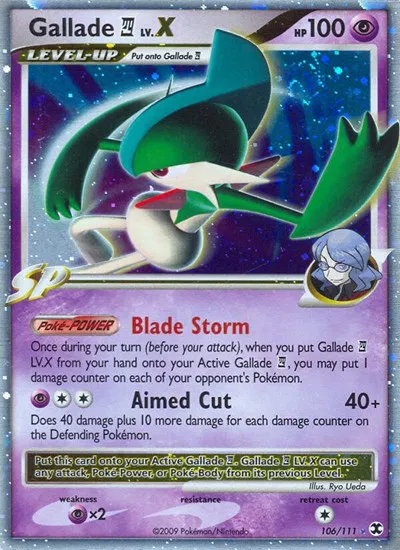
Rising Rivals belongs to the Platinum Series, where Pokemon SP and LV.X cards give the set a trainer-owned identity that modern rarity labels do not capture.
Price and chart data update with BinderDex · Last refreshed Oct 12, 2026. Editorial commentary reflects the article's published snapshot.
#8 Bulbasaur - Legendary Collection
Legendary Collection is one of the strangest reprint sets in Pokemon. It brought early-card nostalgia back into booster packs, then gave collectors the fireworks reverse holo pattern that still looks unlike almost anything else in the TCG. Even when the card is a familiar species, the treatment changes the object.
Bulbasaur moved from $198 to $350. That is the kind of move that makes sense when you remember what Legendary Collection does well: it turns first-generation familiarity into a distinct visual collectible. Bulbasaur is not rare by character identity, but a clean Legendary Collection copy lives in a different lane from a normal old Bulbasaur.
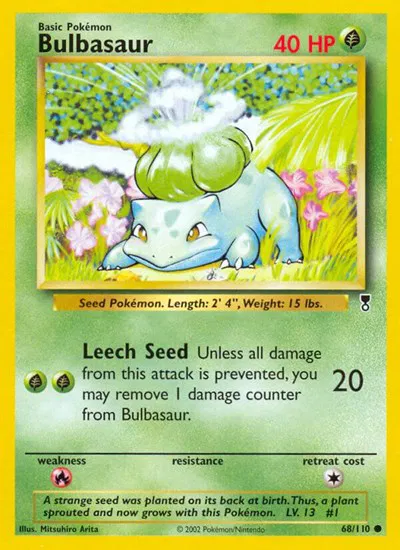
Legendary Collection's fireworks reverse holo identity is a major part of the set's collector appeal, even when the Pokemon is a familiar Gen 1 staple.
Price and chart data update with BinderDex · Last refreshed Oct 4, 2026. Editorial commentary reflects the article's published snapshot.
#9 Dragonite (Cosmo Holo) - XY Promos
XY Black Star Promos are messy in the way promo ecosystems often are. There are product promos, retail promos, special holo treatments, and long-running numbering that does not behave like a normal expansion checklist. Dragonite's Cosmo Holo version belongs to that world.
Dragonite demand helps explain the move from $58 to $150, but the promo-version problem is the real check: collectors ask which Dragonite they own. They ask which Dragonite, from which release path, with which foil treatment. Promo cards reward that kind of specificity.
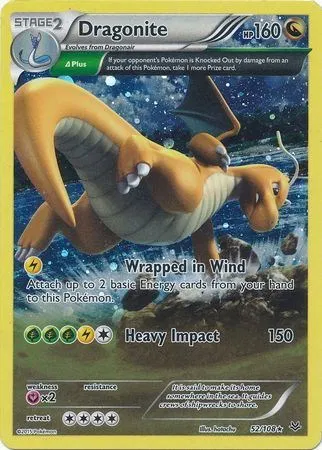
XY Promos are a distribution maze. For Dragonite, the Cosmo Holo label is part of the collectible identity.
Price and chart data update with BinderDex · Last refreshed Oct 12, 2026. Editorial commentary reflects the article's published snapshot.
#10 Houndoom - Neo Revelation
Neo Revelation is remembered for introducing Shining Gyarados and Shining Magikarp, but its normal holo lineup has its own following. Houndoom is one of those cards that feels more expensive in collector memory than its rarity line alone would suggest: dark palette, Johto era, WotC holo texture, and Mitsuhiro Arita art.
The move from $244 to $400 is not a blow-off spike. It is a vintage holo being pulled higher in a week where older exact prints are already leading the board. If Neo Destiny is the headline through Shining Tyranitar, Neo Revelation is the supporting evidence that the Neo block broadly deserves attention.
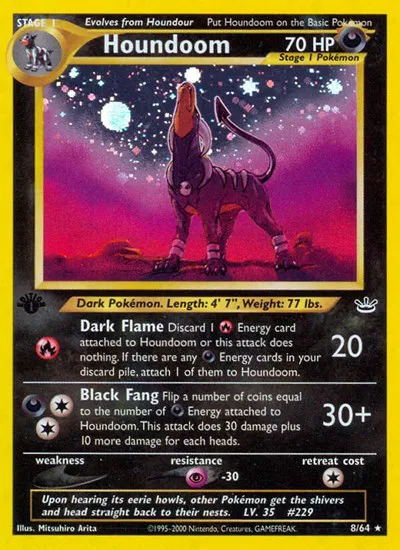
Neo Revelation carries the first major Shining Pokemon moment, but Houndoom shows that standard Neo holos can still move when collector attention rotates into the block.
Price and chart data update with BinderDex · Last refreshed Oct 11, 2026. Editorial commentary reflects the article's published snapshot.
#11 Gengar (H9) - Skyridge
Skyridge is the kind of set where the set name can be as important as the card name. It was the third and final English e-Card main expansion, and Bulbapedia notes the English release has 182 cards. It also introduced Crystal Type Pokemon, one of the mechanics that gives the set its identity.
The seven-day change is $339, from $1,814 to $2,153. On percentage alone, that looks modest. In dollars, it is serious. Skyridge Gengar already lives in a high-price neighborhood, so even a smaller percentage move can add hundreds of dollars. This is not a sleeper waking up. It is a top-shelf e-Card era card shifting within an already thin collector market.
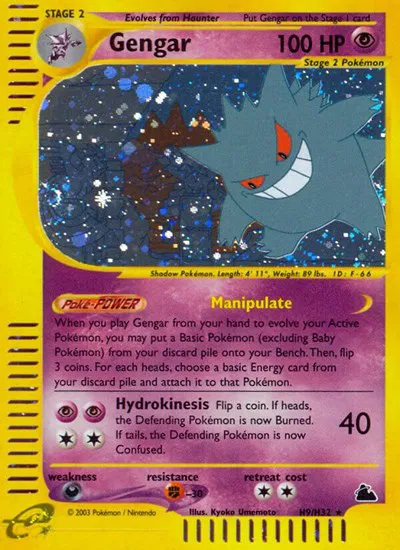
Skyridge is the final English e-Card main expansion. High-end holos from this set can move meaningfully even when the percentage change looks restrained.
Price and chart data update with BinderDex · Last refreshed Oct 12, 2026. Editorial commentary reflects the article's published snapshot.
#12 Regirock ex - EX Hidden Legends
EX Hidden Legends is a Regi set in spirit as much as in packaging. Regirock, Regice, and Registeel were central to the era's Hoenn mythology, and the expansion's identity leans into sealed-away legends, Ancient Technical Machines, and ex-era power.
Regirock ex moved from $78 to $159. That jump is smaller than the vintage WotC moves, but it shows the same collector behavior from another era: exact ex-era legendaries with clean images and clear set identity are getting attention. The card is Regirock at the beginning of its TCG history, in the set where the Pokemon debuted.
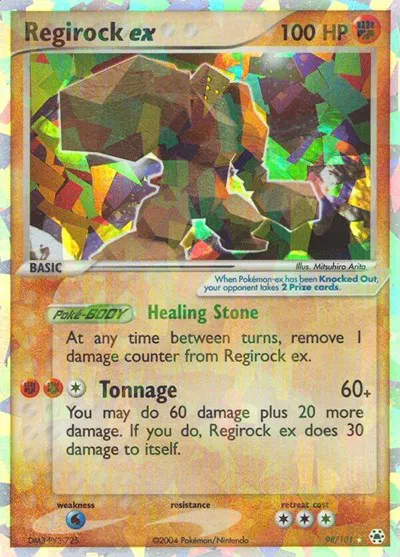
EX Hidden Legends is built around Hoenn's hidden legendary structure. Regirock ex matters because the Pokemon and the set theme point in the same direction.
Price and chart data update with BinderDex · Last refreshed Oct 12, 2026. Editorial commentary reflects the article's published snapshot.
#13 Dark Charmeleon [W Stamped] - WoTC Promo
Dark Charmeleon [W Stamped] is a promo collector's card more than a set collector's card. The W stamp changes the conversation. A normal Dark Charmeleon is one thing; a stamped WotC-era variant is another, especially for collectors who build around distribution quirks.
The move from $408 to $591 fits the week. Stamps, staff labels, promo variants, and older distribution paths keep showing up in the data. The Pokemon helps, of course. Charmeleon sits inside the Charizard family tree. The stamp is what separates this copy from ordinary middle-evolution cards.
![Dark Charmeleon [W Stamped]](https://assets.binderdex.com/collectr/pkmn/wotc-promo/180834.jpg)
The W stamp is the point. This is a variant and distribution story as much as a Charmeleon story.
Price and chart data update with BinderDex · Last refreshed Oct 12, 2026. Editorial commentary reflects the article's published snapshot.
#14 Pokemon Center - WoTC Promo
Pokemon Center is the quietest kind of WotC promo: not a huge character card, not a mascot chase, not a modern alt art. It is a Trainer promo from an era when distribution itself could become the collectible feature. That is why these cards can look plain and still move hard.
The line goes from $1,445 to $1,772, a $327 increase on an already expensive raw/NM card. The key is not spectacle. The key is that high-end promo cards can have thin supply, uneven condition, and a collector base that understands the release history. This is a reminder that price-spike lists are not always about the prettiest card in the collage.

WotC promo cards can be release-history collectibles. Pokemon Center shows how a non-Pokemon card can still matter when supply and condition are tight.
Price and chart data update with BinderDex · Last refreshed Oct 11, 2026. Editorial commentary reflects the article's published snapshot.
#15 Blastoise - POP Series 3
POP Series 3 came through Pokemon Organized Play, not a standard booster release. Bulbapedia lists it as a 17-card special set with a short April to August 2006 release period, and notes Blastoise also appeared as a Cosmos Holo through a Crystal Trainer Set promotion.
That context does a lot of work. Blastoise moved from $77 to $150, and the card is carrying multiple forms of collector memory: a Kanto starter, organized-play distribution, and a short-lived POP Series checklist. The move is not huge compared with Shining Tyranitar, but it fits the board's theme perfectly. This is a week where distribution history is being rewarded.
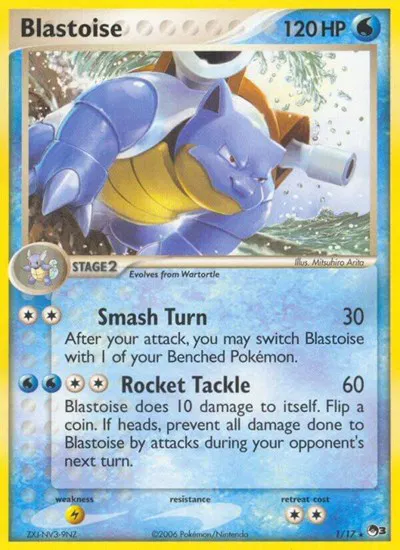
POP Series 3 was a short-lived organized-play promo set. Blastoise adds Kanto starter demand to a release path that already has scarcity baked in.
Price and chart data update with BinderDex · Last refreshed Oct 12, 2026. Editorial commentary reflects the article's published snapshot.
How to read this board
The pattern is not simply "old cards up." The better read is more specific: exact-print vintage cards, older promo variants, and visually distinct set identities are carrying the week, mostly in markets where a few clean copies can change the chart.
That distinction matters because a raw/NM spike can come from very different places. A Skyridge holo has one supply story. A Staff prerelease promo has another. A Team Up alternate full art has a different audience entirely. The same chart shape does not mean the same market behavior.
BinderDex linkKeep movers separate from owned cardsUse a watchlist to track cards that deserve another look without mixing them into the collection you already own.
Final read
Shining Tyranitar is the headline, but it is not the whole read. This week is about collector specificity: Shining secret rares, LEGEND halves, Shadowless Base Set holos, TAG TEAM alternate art, Staff stamps, W stamps, e-Card scarcity, and organized-play promos.
That is the kind of board where the name on the card is only the first clue. The set, print, variant, release path, condition lane, and repeated sold context decide whether the move has weight. The practical move is to put these on a watchlist and see which cards hold their new range after the first spike.
Keep the weekly move in context
Use How to Track Pokémon Card Prices before treating one spike as a durable trend, then compare the June 10 price-spike board for persistence.
Know exactly what is in your collection.
Download BinderDex on iPhone or Android to track exact printings, organize your binders, and follow card and sealed product values in one place.
Prefer mobile?