How To Track Pokemon Card Prices Without Chasing Every Spike
Watch exact cards before reacting to spikes.
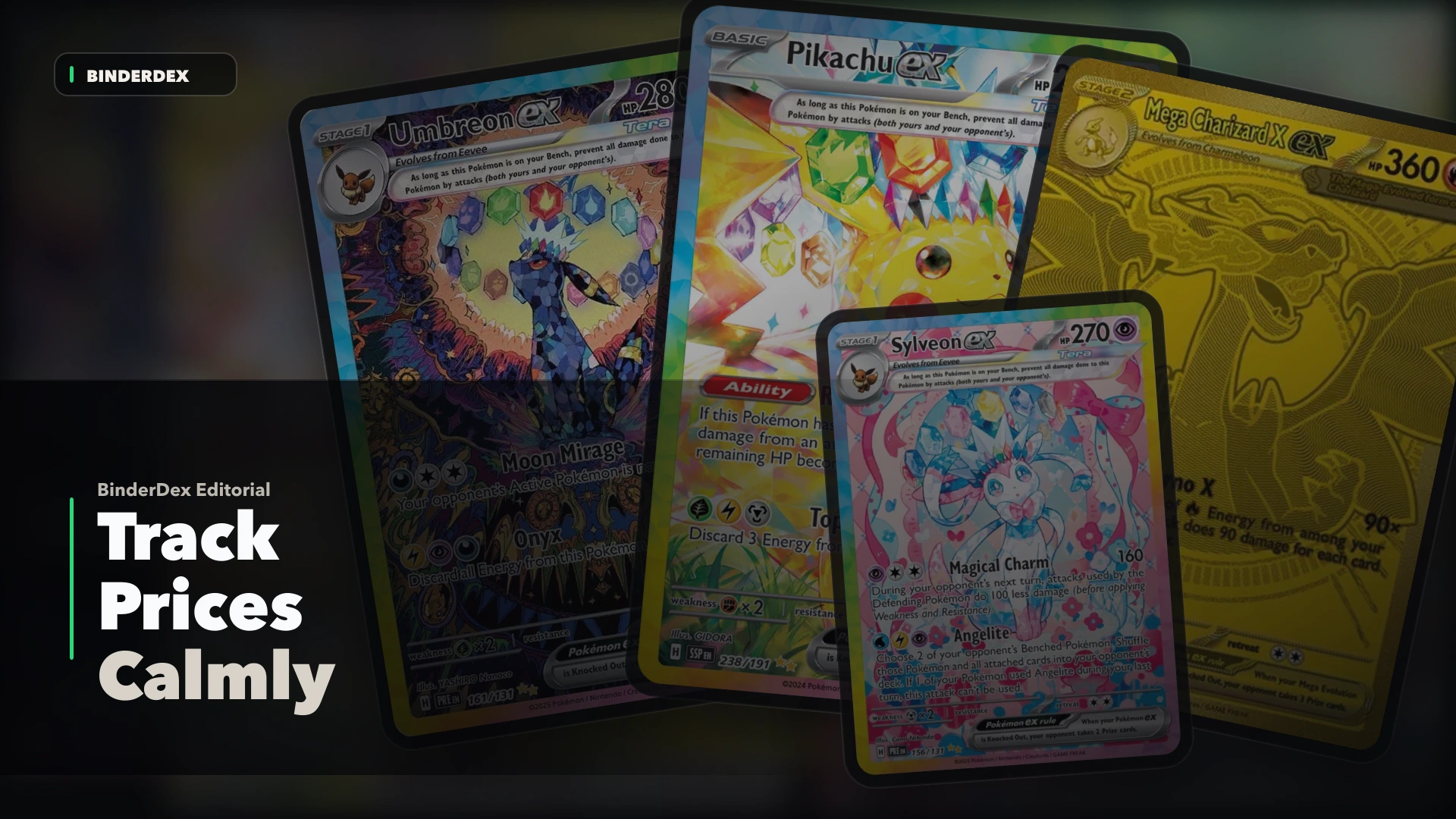
The best way to track Pokemon card prices is to watch exact cards, not broad names. A watchlist entry should name the card page, set, number, variant, condition lane, current context, and reason before the next price move arrives.
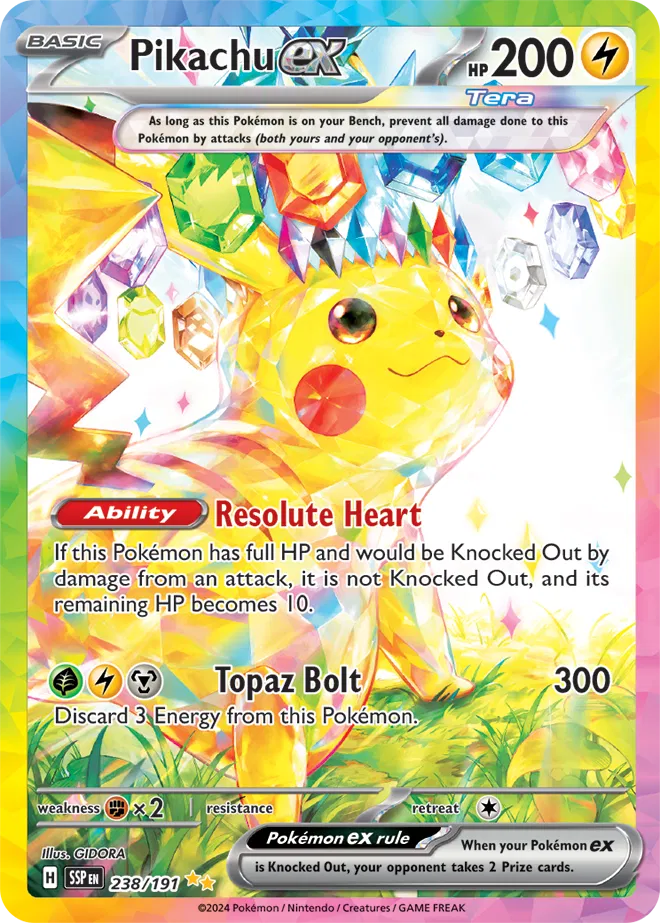
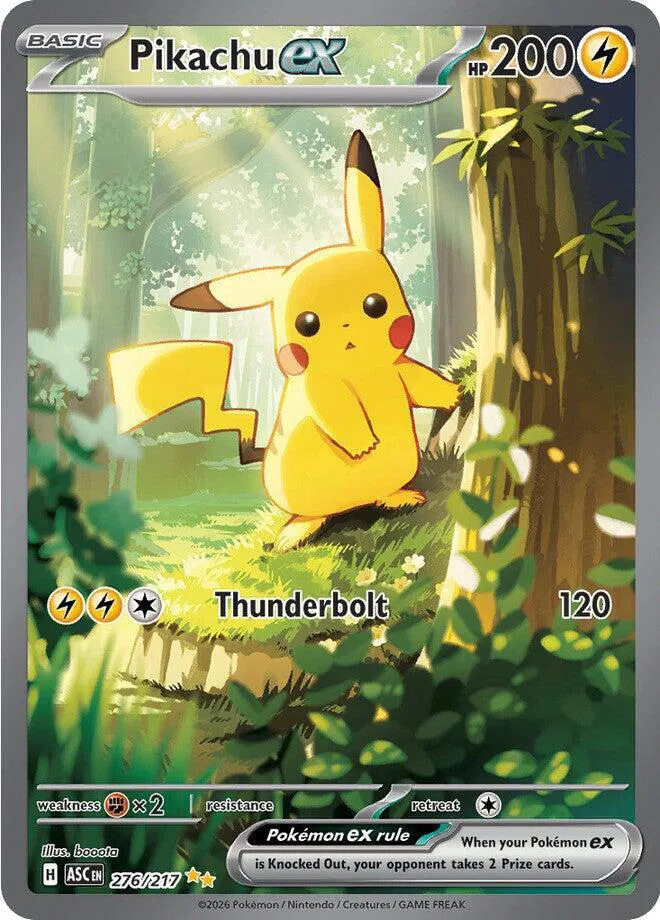
That matters because "Pikachu ex is moving" is not a decision. "Pikachu ex, SSP 238/191, English raw, set-completion target, verify sold comps next Friday" is a decision queue.
A good watchlist slows down hype, separates owned cards from possible targets, and makes each price move easier to judge. If the card only matters while the chart is green, it probably does not belong there.
- Use exact card pages before trusting a price trend.
- Put possible targets in a watchlist before they enter your collection plan.
- Track the reason: set completion, favorite Pokemon, artwork, grading review, duplicate route, or cooldown.
- Compare BinderDex context with marketplace evidence before a transaction or trade discussion.
- Treat most sudden spikes as a prompt to investigate, not as a final decision.
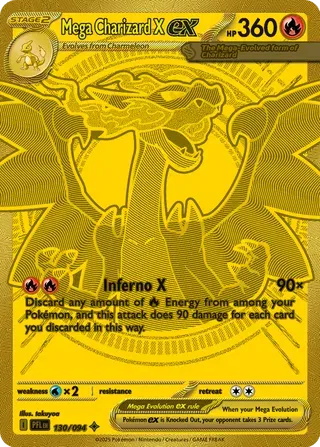
These are examples where a broad name like Charizard, Pikachu, or Umbreon is not enough. Set, card number, condition lane, and reason decide what the watchlist means.
Why tracking prices over time matters
Most bad collecting decisions happen when a collector treats one price as the whole market.
One seller can make a card look expensive by listing high. One damaged sale can make it look cheap. A chart can jump before matching sold examples repeat. The useful question is whether the movement changes the card's route.
Tracking prices over time helps you answer that calmly. Repeated direction across multiple checks deserves attention. A single jump deserves a note, not a rushed decision.
The note can be plain: "wrong language in the comp," "one low-volume sale," "active asks moved but sold context did not," or "same condition lane repeated twice." Those notes are not busywork. They are what keep a watchlist from turning into a chase list.
When the number itself still feels unclear, use how to check Pokemon card value before turning the card into a watchlist rule.
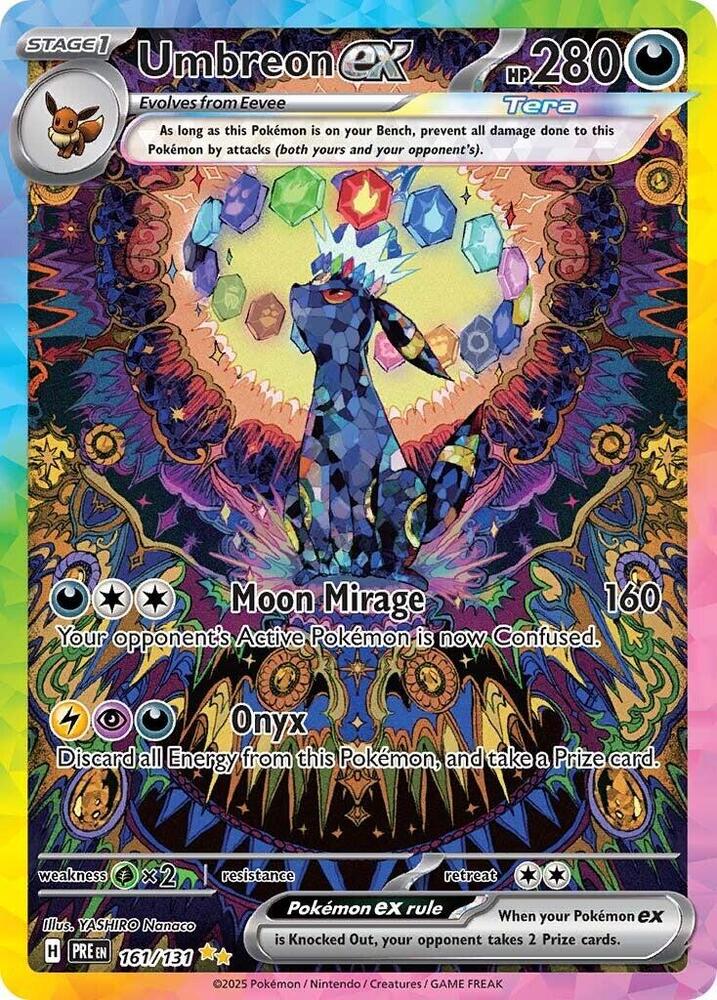
Umbreon ex
Prismatic Evolutions #161/131
Umbreon cards can have very different markets by set, number, rarity, and condition. If you only track the Pokemon name, you are not tracking the decision you actually need to make.
Open the BinderDex card pageA watchlist is stronger when it follows the exact print instead of a broad Pokemon name. The card page keeps identity, price context, and the reason for watching together.
Price and chart data update with BinderDex · Last refreshed Oct 11, 2026. Editorial commentary reflects the article's published snapshot.
The best tracking workflow
Start with the exact card. Then decide where it belongs before the next alert shows up.
For each watched card, write five things: exact print, condition lane, reason, evidence needed, and review date.
Example: "Umbreon ex PRE 161/131, English raw, favorite Pokemon watch, ignore slab charts, review after several matching sold examples."
Then choose the next state before the next price move: watch, verify, hold, or remove. Move it into your BinderDex portfolio only after you own it.
This workflow is intentionally boring. That is the point. A watchlist should protect you from urgency, not create more of it.
BinderDex linkStart with exact BinderDex card pagesUse card search when a card name is too broad. The exact print is what determines whether the price context is useful.
Source checks that belong in tracking
No single tracker answers every question. Each source has a job.
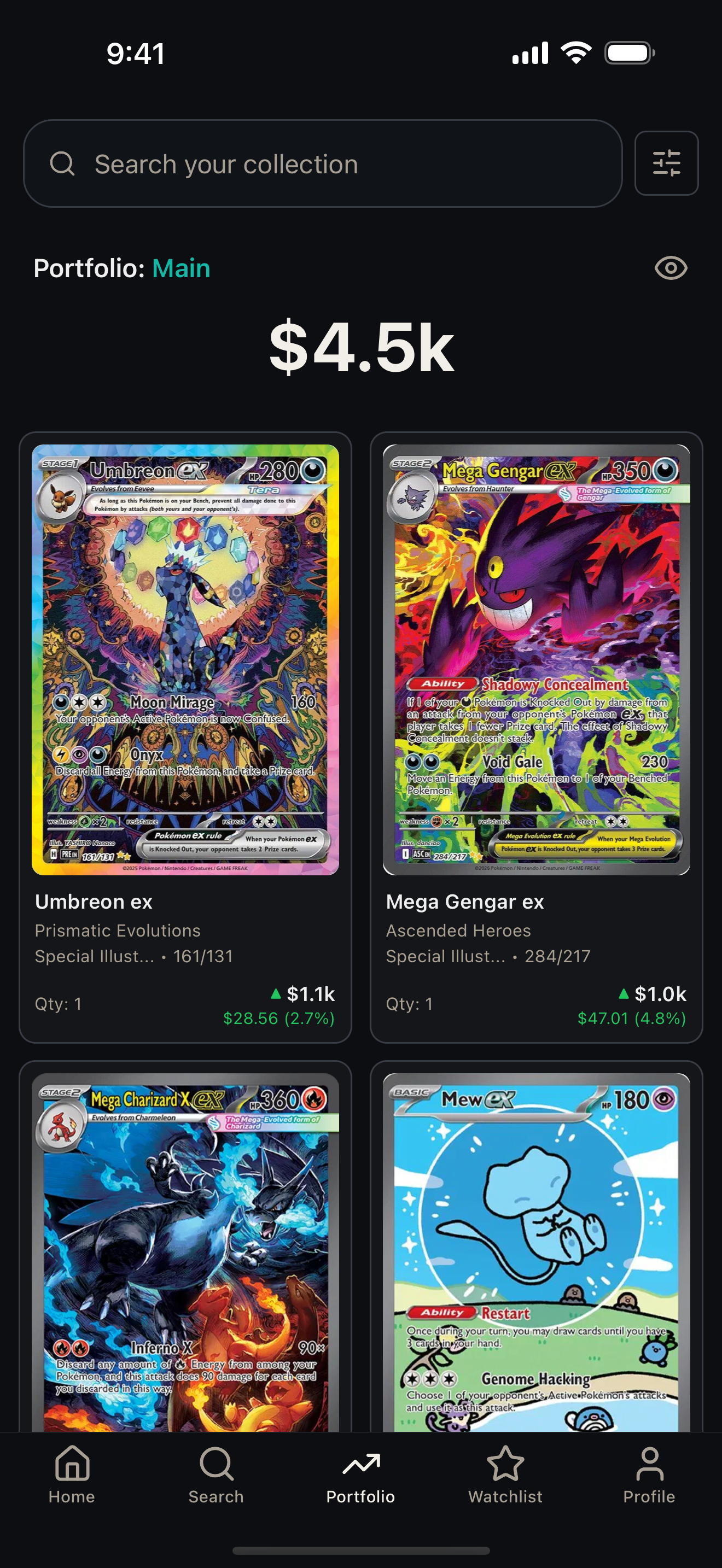
BinderDex keeps the exact card, image, set context, watch reason, and owned-card status together. That is the home base.
TCGplayer-style pages help when the watched card is an English single and the product page maps cleanly to the condition lane. eBay sold listings help when photos, slabs, odd variants, or completed-sale context matter.
PriceCharting helps with longer movement, especially when raw and graded lanes need to be compared without blending them into one note. Grading-company pages only matter when the watched card has become a slab-specific review.
Spreadsheets can still help with custom thresholds, but they get weaker when the card identity and images drift away from the note.
The best setup is not one tool. It is a stack: BinderDex for identity and workflow, marketplace pages for current options, completed sales for evidence, and source notes for what changed.
What BinderDex is best for
BinderDex is strongest when the question is not “what is this card worth?” but “what should I do with this specific card?”
Use BinderDex when you want exact-card research to stay attached to the decision.
A set-completion watch might say: "Pikachu ex SSP 238/191, raw English, wait for cleaner sold context." A favorite-Pokemon watch might say: "Umbreon ex PRE 161/131, ignore graded charts unless this becomes a slab route."
A grading-review watch can be narrower: "Mega Charizard X ex PFL 130/094, needs back photo and current grading-cost context before slab comps matter."
Those notes are more useful than a long list of cards with no reason. They explain why the card is on the watchlist and what evidence would change the route.
A useful watchlist can mix high-pressure cards, modern chase cards, and lower-pressure binder targets. The point is to compare decisions, not chase every move.
Where BinderDex is not enough
BinderDex should not be the only thing you check before money, cards, or grading time move.
Before a transaction or trade discussion, compare the watched card against current marketplace context. Look at active listings, completed sales, condition notes, seller quality, shipping, and whether the copy is raw or graded.
Public marketplaces like TCGplayer and completed-sale views on eBay can help confirm whether the BinderDex signal matches real options.
The mistake is using marketplace tabs as the whole system. They are good for transaction context. They are bad at remembering why the card mattered to your binder in the first place.
If you are still choosing source routes, use how to check Pokemon card value. If the card needs a range instead of a watch note, use how to price Pokemon cards without guessing.
When a price move deserves attention
Not every movement deserves the same response. A useful watchlist separates noise from changes that affect the card's route.
- Identity mismatch: the move came from a different set, number, language, or finish.
- Condition mismatch: raw, damaged, and graded examples are being mixed together.
- Repeated movement: multiple checks point in the same direction instead of one isolated spike.
- Low-volume signal: one sale moved the chart, but the card still has thin evidence.
When one of those signals appears, update the reason on the card instead of jumping straight to action. Cards that still matter after the urgency fades can stay on the watchlist. Cards that only felt important during the spike can be removed.
For example, a watched Pikachu ex that moves after one low-quantity sale does not need an automatic response. Check whether the sale matched the same set, language, finish, and condition.
A weak match gets the note "low-volume spike, verify later." Several matching sales can move the note to "review trade or listing context." The action changes only after the evidence changes.
That is exactly why source timing belongs in the note. In the June 4 BinderDex source check, Pikachu ex 276/217 from Ascended Heroes was up $77.50 over seven days in Collectr NM holo, while Mega Gengar ex 284/217 was down $23.77 in the same source lane. The older May 18 TCGplayer NM rows still told a different order. A watchlist should preserve that difference instead of flattening it into "Ascended Heroes is up."
Watched cards that become grading candidates need grading cost context and the pre-grade checklist before the chart is enough.
Build a small watchlist
Track fewer cards than you think. Five well-noted cards are more useful than fifty cards with no reason.
Start with one card for each kind of decision:
- Set-completion target: exact card, raw lane, review when several matching sold examples appear.
- Favorite Pokemon watch: exact print only, ignore name-wide movement.
- Grading-review candidate: raw card plus likely grade range, cost, timing, and slab source lane.
- Cooldown card: interesting only after the current spike has aged.
- Owned-card check: portfolio note, not a target note, with condition kept attached.
For normal collecting, a weekly review is enough. Daily checking only makes sense when a card already has a clear route and condition or availability is genuinely hard to replace.
If the card has no reason after the next review, remove it. If the reason remains but evidence is thin, keep the note cautious.
The tracking trap
The trap is turning your watchlist into another feed.
If every card on the list is there because it moved yesterday, the watchlist is not helping. It is just organizing urgency. Remove cards where you cannot explain the reason anymore. Keep cards where the collector goal is still real.
BinderDex linkUse the watchlist as a decision queueWatchlists work best when every card has a reason and a next action. If the reason disappears, remove the card.
FAQ
How often should I check Pokemon card prices?
Weekly is enough for most watchlists. Daily checks tend to turn a watchlist into a feed unless a card already has a specific time-sensitive reason.
What should I track besides price?
Track exact card identity, condition target, reason, review date, and next action. The reason matters because it keeps a price move from becoming the whole decision.
When should I ignore a price spike?
Ignore or downgrade a spike when it comes from one sale, a mismatched condition lane, a wrong variant, or a card that no longer fits your collection goal.
How should I handle low-volume cards?
Use wider ranges and slower decisions. Low-volume cards can be meaningful, but thin evidence should make the watch note more cautious, not more confident.
Final recommendation
Use BinderDex as the home base for exact card tracking, then use marketplaces as confirmation before a transaction or trade discussion. Start with five cards you actually care about, give each one a reason, and review them once a week. If a card only feels important because the price moved today, do not act yet. If it still fits your binder after the urgency fades, it may deserve more research.
Know exactly what is in your collection.
Download BinderDex on iPhone or Android to track exact printings, organize your binders, and follow card and sealed product values in one place.
Prefer mobile?