What Is A Misprint Pokemon Card?
A weird card is not automatically an error card.
The Short Answer
A misprint Pokemon card is a card with a plausible production error, such as a printing, cutting, alignment, ink, texture, stamp, or packaging anomaly. The key is evidence that the issue happened during production rather than after the card entered circulation. The bigger collector issue is verification. Interesting does not equal factory error, and damage should not be dressed up as a misprint.
My read is that misprint is an evidence claim, not a vibe. Misprint cards sit at the intersection of identity, condition, and proof. A card can be unusual, valuable to a niche collector, damaged, fake, altered, or simply normal variation. The responsible approach is to identify the base card first, document the anomaly second, and compare it with known production patterns before making a claim.
- Exact base card: Set, number, language, variant. You cannot evaluate the anomaly until you know what the normal card should look like.
- Production pattern: Ink, cut, alignment, stamp, texture, layer, packaging. Factory-origin clues should be described specifically instead of calling every oddity a misprint.
- Damage screen: Creases, bends, water, scratches, trimming, stains. Post-production damage can look dramatic but does not become an error card.
- Verification route: Comparison copies, expert review, grading-company eligibility. The stranger the claim, the more documentation it needs.
I would slow down any misprint claim until it can answer three questions: what is the normal card, what exactly is abnormal, and why does the evidence point to production rather than later damage?
Sources To Check Before Naming The Card
Use different sources for different jobs. The official Pokemon TCG database is useful for identity. CGC's error guide is useful for taxonomy. PSA's standards are useful for damage and alteration language. Community indexes are useful for known examples, not final proof by themselves.
 IdentityPokemon TCG database supportStart here for exact card identity: name, expansion, rarity, card type, and expected text.
 TaxonomyCGC Cards Error GuideUse this to name the possible error type. CGC documents square cuts, added ink, albino backs, double printing, holo errors, fold overs, printer hickeys, and more.
 Damage screenPSA grading standardsUse this for trimming, recoloring, altered stock, cleaning, minimum size, and miscut no-grade language.
 Known examplesBulbapedia Error CardsUse this as a community-maintained index of known Pokemon TCG error-card examples. Helpful lead, not an official ruling.
 Collector databaseRubenMisprints Pokemon Errors DatabaseUse this as a collector-maintained gallery and database for Pokemon error routes. Helpful for pattern finding; still verify against the card and official/grading guidance.Fake-error warningCGC Fake Error Card: Major Miscut RaichuUse this as a cautionary example: CGC returned a severe-looking Fossil Raichu ungraded after determining it was cut from an uncut sheet after leaving the facility.
Real Examples To Compare Against
The best way to make this topic less vague is to anchor the claim in examples. These are not examples to copy into a listing. They are comparison routes. If your card resembles one of them, the next move is to verify the exact card, photograph the anomaly, screen for damage, and check whether the same production pattern is documented elsewhere.
| Example | Source route | Why it matters | What to verify on your card |
|---|---|---|---|
| Sword & Shield Pikachu with two square corners | CGC Error Guide | Cutting and corner-rounding route. | Whether the corners look factory-cut and whether the era/provenance creates NFC risk. |
| Celebrations Professor's Research square cut | CGC Error Guide | Square-cut route with a modern Pokemon example. | Whether the card was factory cut rather than hand cut from a sheet. |
| 1st Edition Fossil Lapras with additional ink on the front | CGC Error Guide | Ink-route example where the anomaly belongs to the print process. | Whether the mark sits in the printed layer rather than on top of the surface. |
| 1st Edition Jungle Vaporeon with additional ink on the back | CGC Error Guide | Back-side ink-route example. | Whether the color/placement matches a production ink issue instead of staining. |
| 2020 Lightning Energy with an albino back | CGC Error Guide | Missing-color route on the card back. | Whether the issue is across the print layer, not sun fading or chemical exposure. |
| Jungle Kangaskhan with doubled holo pattern | CGC Error Guide | Foil-layer route, not ordinary holo scratching. | Whether the holo pattern is doubled consistently under light. |
| Boldore from Evolving Skies with fold over | CGC Error Guide | Production-sequence route. | Whether print/cut behavior proves the fold existed before finishing. |
| Glimmet from Twilight Masquerade with printed fold over | CGC Error Guide | Obstruction/fold route with modern example. | Whether the fold preserves a production sequence instead of showing handling stress. |
| Fossil Gengar with misaligned print layer | CGC Error Guide | Registration route. | Which layer shifted and whether the card still matches a normal baseline. |
| Base Set Starmie with shifted yellow layer | CGC Error Guide | Color-plate route. | Whether one print layer shifted rather than the whole card being damaged. |
| Base Set Ninetales with missing attack damage text | Bulbapedia error-card index | Known printed-text route. | Exact version, set, language, and whether the missing text is printed that way rather than rubbed away. |
| Base Set Vulpix with "HP 50" order | Bulbapedia error-card index | Known text-layout route. | Exact print/version; this is a known printed-card issue, not a one-off anomaly. |
| Base Set Voltorb with "Monster Ball" wording | Bulbapedia error-card index | Known wording route. | Exact version and language; community indexes are a lead, not final proof. |
| Severe-looking Fossil Raichu miscut cut from an uncut sheet | CGC fake-error case study | Warning route: authentic card, unsupported factory-error claim. | Corner radius, sheet provenance, and whether the cut happened inside the factory. |
The pattern is the important part. A cutting error needs cut evidence. An ink error needs print-layer evidence. A text error needs exact-version evidence. A fold-over needs production-sequence evidence. Without the right kind of evidence, the card may still be interesting, but the claim should stay provisional.
The Bigger Collector Issue
The trap is letting excitement become attribution. A card can look strange for several reasons, and only some of them are production errors. Until the normal baseline and damage screen are clear, the strongest label is usually "candidate" or "needs verification."
That restraint does not make the card less interesting. It makes the claim more useful. Serious misprint collectors care about the evidence trail because the evidence is what separates an error card from a damaged card with a story.
A Better Workflow
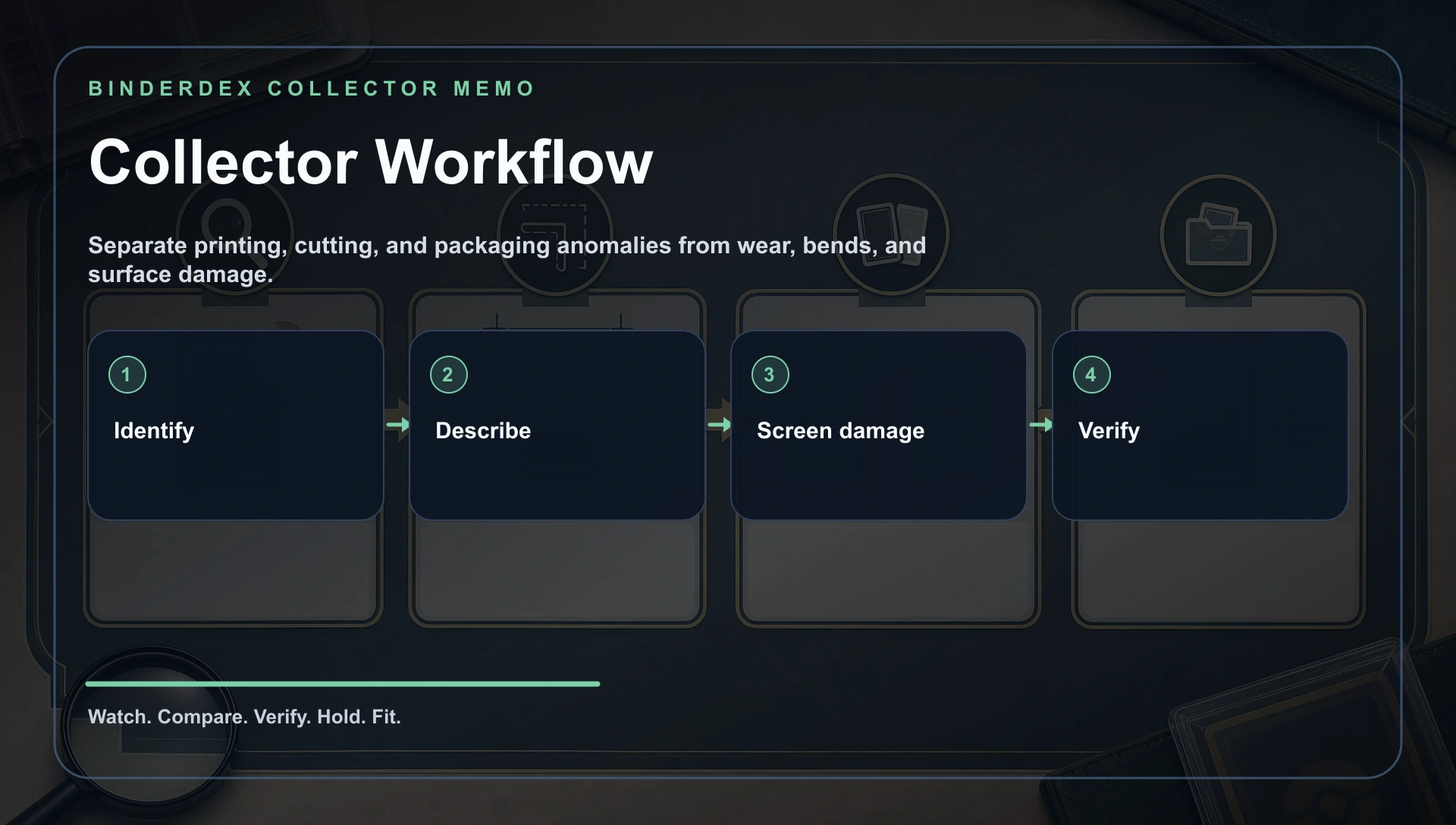
1. Identify the normal card first
Start with the exact card identity: set, number, language, rarity, variant, and expected finish. Use official or established card references to understand what the card should look like. A misprint claim without a normal baseline is guesswork. Once the base card is known, photograph the card beside a normal copy or a trusted reference if possible.
The baseline is the anchor. Without it, every later observation floats, and the anomaly can be exaggerated or misnamed.
2. Describe the anomaly without hype
Use precise language: miscut, off-center, shifted ink layer, missing color, texture issue, wrong stamp, crimping, obstruction, registration shift, or packaging-related issue. Avoid broad claims like one of a kind unless evidence supports it. Serious collectors want to know what happened, how visible it is, and whether similar examples exist.
Precise language keeps the claim testable. "Shifted ink layer" can be checked; "crazy rare misprint" cannot.
3. Separate misprint from damage
Damage usually leaves physical stress: creases, whitening, dents, scratches, water marks, staining, peeling, or uneven trimming. Production anomalies often interact with the print layer, cut, texture, stamp, or packaging process. The difference is not always obvious, which is why documentation matters. If the evidence is unclear, say verify more rather than forcing the label.
The damage screen is not pessimism. It is the control that keeps normal wear, water, trimming, and pressure marks from becoming unsupported factory-error claims.
4. Decide what the card is for
A confirmed or plausible misprint can be a collection centerpiece, a research card, a grading candidate, or a watchlist item. It can also be a damaged card with a good story. BinderDex can keep the exact identity, anomaly notes, photos, and next action together so the card is not reduced to a vague claim.
The card can still be worth keeping even if the claim stays provisional. A neutral note is better than forcing certainty the evidence cannot carry.
Real Error Categories And Examples
The reason to learn categories is not vocabulary. It is to keep the claim testable. A named category tells you what evidence should exist and what damage lookalikes must be ruled out.
Cutting errors
A square-cut or square-corner card missed part of the corner-rounding process. CGC shows Pokemon examples including a Sword & Shield Pikachu with square corners and a Celebrations Professor's Research square cut.
This route needs caution. CGC also warns that many Wizards-era square-cut cards are not factory cut, so provenance can matter. A card with sharp corners is not automatically a factory error.
Ink and print-layer errors
Additional ink can come from ink on a plate or roller. CGC uses examples such as 1st Edition Fossil Lapras with added ink and Jungle Vaporeon with added ink on the back.
Missing or abnormal ink can also be real, but it has damage lookalikes: sun fading, stains, cleaning residue, surface rub, or water exposure. The evidence should sit in the print layer, not only on top of the card.
Holo and texture errors
Some errors live in the foil or texture layer rather than the printed text. CGC's guide includes a Jungle Kangaskhan doubled holo pattern and other foil-layer examples.
This route needs normal-copy comparison. Scratches, roller lines, pressure marks, and surface haze can look like texture anomalies until the card is compared under light.
Fold-over and obstruction errors
A fold-over can happen when cardstock folds before printing or cutting. CGC documents examples such as Boldore from Evolving Skies and Glimmet from Twilight Masquerade.
A real fold-over should show the production sequence. A normal crease after handling usually shows stress, whitening, and pressure damage instead.
Known text or design errors
Known printed errors are different from one-off factory accidents. Pokemon examples often discussed by collectors include Base Set Ninetales with missing damage text, Base Set Vulpix with the "HP 50" order, and Base Set Voltorb's "Monster Ball" wording.
These should be checked as exact versions. A smudged attack box, damaged HP area, or mistranscribed listing is not the same thing as a documented printed error.
Examples That Change The Decision
- A Pikachu with square corners is a cutting-route candidate only after identity and provenance questions are handled.
- A Fossil Lapras with extra ink is an ink-route example; a random stain on a card is not the same claim.
- A Jungle Kangaskhan with doubled holo pattern is a foil-layer example; a scratched holo is a damage-route card.
- A Base Set Ninetales with missing attack damage is a known printed-error route, not a generic "weird text" claim.
- A folded card is usually damage unless the fold shows a production sequence, such as print or cut behavior around the folded area.
These examples matter because they keep the article grounded in routes a collector can actually choose. The best answer depends on the card in front of you, the evidence available now, and the collection you are trying to build. A strong process should make the next move clearer without pretending every card deserves the same level of research.
The Evidence Standard
Use a simple publication standard before you act: can another collector follow your reasoning from the card to the decision? That means the exact card is identified, the condition language is honest, the route is named, and the source behind any factual claim is current enough to rely on. If any one of those pieces is missing, the answer should stay provisional.
This standard also protects the tone of the decision. A collector does not need certainty about everything. A collector needs to know which uncertainty matters. If the card identity is uncertain, verify. If condition is uncertain, photograph and inspect. If the route is uncertain, compare the work required by each path. If the source is stale, check the current official or marketplace page. The right move is the one that improves the decision without pretending the evidence is stronger than it is.
For misprints, the evidence standard is higher because the label changes the story of the card. Another collector should be able to follow the reasoning from normal baseline to anomaly category to damage screen to verification route. The claim does not need to be dramatic to be useful. "Miscut candidate with comparison photos" is better than an unsupported "rare error" claim. If the card is interesting but the evidence is incomplete, the honest route is watch, document, and verify.
That discipline protects both sides of the niche. Real error cards deserve better than hype language, and damaged cards deserve honest condition language. A collector can still keep a strange card because it is cool. The issue is what the record says about why it is strange. The record should be calm enough to trust later.
Tradeoffs Before You Act
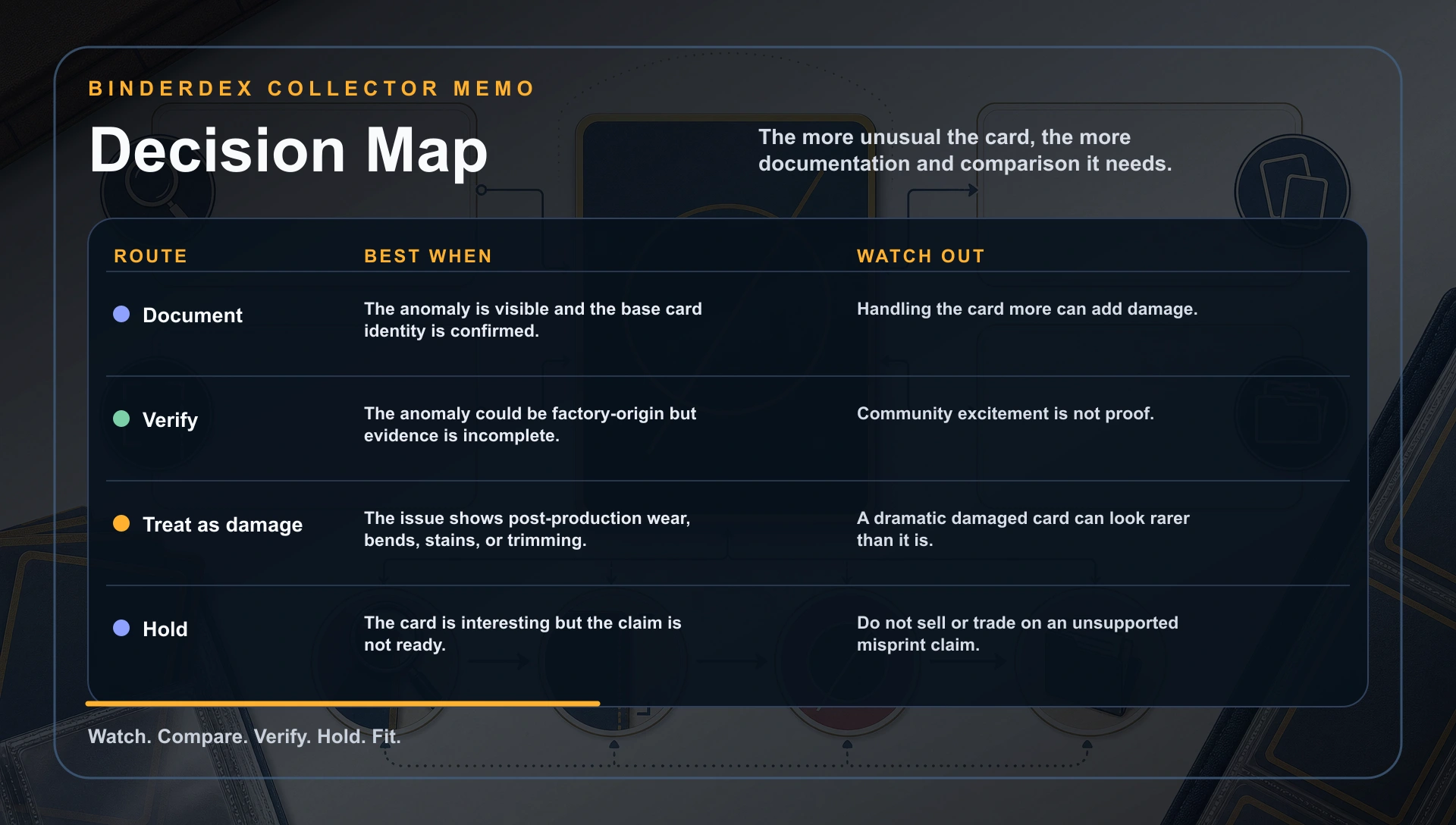
The correct route is rarely automatic. Speed saves time but can hide identity mistakes. Detailed research improves confidence but can consume hours on cards that do not justify it. A marketplace listing can reach more buyers but adds photos, messages, packaging, shipping, and dispute risk. Grading can protect and authenticate a card, but it adds cost, time, and grade uncertainty. Holding can be the right collector move, but only if the card still fits a real collection goal.
| Action | Best when | Check first | Watch out for |
|---|---|---|---|
| Document | The anomaly is visible and the base card identity is confirmed. | Clear photos, normal-card comparison, and description of the issue. | Handling the card more can add damage. |
| Verify | The anomaly could be factory-origin but evidence is incomplete. | Comparison copies, grading-company guidance, and expert review. | Community excitement is not proof. |
| Treat as damage | The issue shows post-production wear, bends, stains, or trimming. | Physical stress marks and surface disruption. | A dramatic damaged card can look rarer than it is. |
| Hold | The card is interesting but the claim is not ready. | Identity, condition, photos, and a neutral note. | Do not sell or trade on an unsupported misprint claim. |
A useful decision matrix does not make the choice for you. It narrows the question until the tradeoff is visible. If two routes still look equally good, wait and gather the missing evidence. Waiting is not indecision when the alternative is acting on a weak signal.
My decision rule is this: the stranger the card, the calmer the language should become. Let the evidence earn the claim. Start with exact identity, then anomaly category, then damage screen, then comparison. If the chain holds, the claim gets stronger. If the chain breaks, the card may still be interesting, but the label should soften.
What would change the answer is better evidence: a normal-card comparison, repeat examples, grading-company guidance, or photos that show the anomaly belongs to the print, cut, stamp, texture, or packaging process. Without that, the card can be watched without being overclaimed. The claim should mature only as the evidence matures.
How BinderDex Fits
BinderDex should support the research, not replace it. For this topic, the product role is to preserve exact-card context: card identity, binder fit, watchlist status, portfolio notes, and the reason a card moved into a given route. BinderDex helps collectors preserve exact card identity and notes before asking whether the anomaly changes the card's role.
That matters because most collection mistakes are not caused by a lack of information. They are caused by information becoming detached from the card. A collector sees a number but forgets the condition. A card gets sorted as bulk but later turns out to fill a set. A slab is compared against raw comps. A misprint candidate is remembered as confirmed even though it was only plausible. Keeping the decision history close to the card makes those mistakes easier to avoid.
Use BinderDex as the operating layer: search the exact card, mark the route, add notes when the evidence is incomplete, and watch the specific version instead of the broad character name. Then use official sources, marketplace pages, and current policy pages to verify the claims that matter before money, cards, or time move.
What To Watch Next
- Normal baseline: Compare against the expected card before naming the error. Risk: Some perceived anomalies are normal variants.
- Physical stress: Inspect for creases, whitening, dents, scratches, and water marks. Risk: Damage is often mistaken for production error.
- Repeat evidence: Look for similar examples or production patterns when possible. Risk: A lone example needs careful language.
- Eligibility: Check grading-company guidance before submitting an unusual card. Risk: Not every anomaly will receive the desired label.
Keep watchlist moves separate from your binder.
Download BinderDex on iPhone to track exact cards, organize portfolio decisions, and avoid turning every short-term price move into a buy.