Pokemon Card Rarity Symbols: What Every Mark Means
Pokemon card rarity symbols explained: circle, diamond, black, white, gold, promo, and Mega-era marks, plus what to check before pricing a card.

A circle means Common. A diamond means Uncommon. One black star means Rare. That is the quick read.
Modern English Pokemon cards add more specific marks: two black stars for Double Rare, two white stars for Ultra Rare, one gold star for Illustration Rare, two gold stars for Special Illustration Rare, and three gold stars for the Scarlet & Violet era's Hyper Rare cards. Mega Evolution sets also introduced the four-pointed gold star used for Mega Hyper Rare.
The catch is age. A single star on a pre-2023 card can cover several older rarity names, so the symbol needs to travel with the set name, collector number, and finish.
- Circle: Common
- Diamond: Uncommon
- One black star: Rare
- Two black stars: Double Rare
- Two white stars: Ultra Rare
- One gold star: Illustration Rare
- Two gold stars: Special Illustration Rare
- Three gold stars: Hyper Rare in the Scarlet & Violet series
- Four-pointed gold star: Mega Hyper Rare in the Mega Evolution series
- Black star marked "PROMO": Promo card, outside the normal booster-pack rarity ladder
Pokemon card rarity symbol chart
Read the lower identity line of the card. On most recent English cards, the set code, collector number, and rarity mark sit close together near the bottom edge. Older layouts can move those details, so check both lower corners before deciding a symbol is missing.
| Symbol or mark | Usual English rarity | What to confirm next |
|---|---|---|
| Circle | Common | Set, collector number, finish, and language |
| Diamond | Uncommon | Set, number, and whether the card is regular or parallel foil |
| One black star | Rare | Card era, because older star cards can use several rarity names |
| Two black stars | Double Rare | Exact Pokemon ex printing and collector number |
| Two white stars | Ultra Rare | Full-art printing, set, and number |
| One gold star | Illustration Rare | Exact artwork and collector number |
| Two gold stars | Special Illustration Rare | Pokemon or Supporter version, texture, set, and number |
| Three gold stars | Hyper Rare | Scarlet & Violet-era set and exact gold card |
| Four-pointed gold star | Mega Hyper Rare | Mega Evolution-series set and exact card number |
| Black "PROMO" star | Promo | Promo number and where the card was distributed |
| Named special rarity | Set- or era-specific rarity | Official card database entry; do not force it into an older chart |
This chart is for English cards. Japanese cards use a different rarity system, and older English eras have categories that do not map neatly to the current symbols.
The 30-second rarity check
Do these five checks in order:
- Read the set name or set code.
- Read the collector number, including both sides of
XXX/YYY. - Read the rarity mark beside it.
- Tilt the card under light to identify regular foil, parallel foil, texture, or a stamp.
- Search the exact set and collector number, then compare only that printing.
That order prevents the most common mistake: finding the right Pokemon but the wrong card.
The collector number matters because two cards can share a name and still belong to different rarity lanes. A number above the advertised set count, such as 188/132, is a strong signal that you are looking at a premium card. It is not a universal rule. Current rarities can also appear at the advertised count, so the official rarity name still wins.
Modern stars need color and shape
"It has two stars" is not enough for a modern card. Two black stars and two white stars mean different things. Two gold stars mean something else again.
The Mega Evolution series adds one more visual trap. Mega Hyper Rare uses a single four-pointed gold star rather than the three ordinary gold stars associated with Scarlet & Violet Hyper Rare cards. Mega Lucario ex 188/132 is a useful card-in-hand example: the four-pointed mark, the Mega Hyper Rare name, and the collector number all support the same identity.
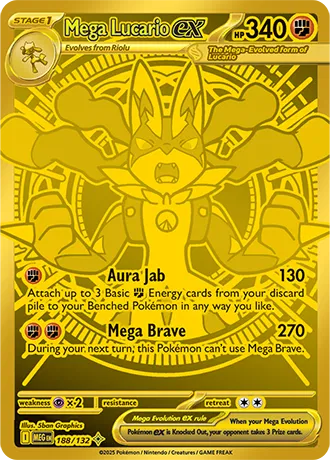
Mega Lucario ex 188/132 is a Mega Hyper Rare. Use its four-pointed rarity mark and exact collector number together; the gold finish alone is not a safe identifier.
Price and chart data update with BinderDex · Last refreshed Oct 11, 2026. Editorial commentary reflects the article's published snapshot.
Now compare that with Mega Gardevoir ex 178/132, a Special Illustration Rare from the same set. The Pokemon name, full-card art, and premium finish can make both cards feel like the same class at a glance. Their rarity marks and collector numbers separate them.
These Mega Evolution cards show why the exact number and printed rarity matter more than a broad search for a Pokemon name.


Foil is a finish, not a rarity answer
A shiny card is not automatically rare. Parallel foil cards, often called reverse holos by collectors, can exist at Common, Uncommon, or Rare. The foil treatment changes how the card looks. It does not replace the printed rarity.
Recent Rare cards are usually holographic, while older sets can separate Rare and Rare Holo categories. That is another reason to identify the set before using the shine as evidence.
If the finish is the confusing part, use Pokemon holo vs reverse holo cards explained. If the expansion icon is the mystery, use Pokemon card set symbols explained. When the printed details themselves do not agree with the expected card, move to how to tell if a Pokemon card is fake before treating the foil as a rarity clue. The two symbols answer different questions.
Rarity symbol versus set symbol
The rarity symbol tells you the card's classification inside a set. The set symbol or code tells you which expansion the card belongs to.
Mix those up and a correct rarity read can still lead to the wrong printing. Older cards may have the expansion symbol near the art box and the rarity symbol beside the collector number. Modern cards usually collect more of that identity information along the bottom.
When a scanner result disagrees with the printed set code or collector number, trust the card-in-hand evidence and verify it in the official database. Artwork alone is a weak identifier because Pokemon cards reuse characters, attacks, and sometimes illustrations.
A rare card is not automatically valuable
Rarity describes the card's lane inside its set. Price depends on the exact printing, condition, collector demand, supply, and the market at the time you check.
A clean Illustration Rare of a popular character can sell above a mechanically scarcer card that fewer collectors want. A damaged premium card can fall below a clean lower-rarity copy. Promo distribution can also matter more than the word "Promo" itself.
Use the rarity mark to narrow the lookup. Then move to the exact card page and condition. If price is the next job, how to check Pokemon card value gives you the safer comparison order.
Edge cases that deserve a second check
Some legitimate cards have no normal rarity symbol. Basic Energy, certain special products, and some promotional releases can use different markings or omit the usual circle, diamond, or star. A missing symbol does not prove a card is fake.
Older cards also compress more categories into a single star. A one-star card printed before the Scarlet & Violet series might be Rare, Rare Holo, or one of several era-specific premium rarities. Do not assign a modern rarity name to it by symbol alone.
Set-specific categories deserve the same caution. Mega Attack Rare, Amazing Rare, Radiant Rare, Shiny Rare, and other named lanes belong to particular eras or products. Check the exact official database entry rather than trying to rank every unusual mark on one permanent ladder.
Questions collectors ask
What do the symbols on Pokemon cards mean?
Circle means Common, diamond means Uncommon, and one black star means Rare. Modern cards use additional black, white, gold, and four-pointed star patterns for premium rarities. Read the set and collector number at the same time.
How do you read a Pokemon card rarity?
Find the collector number near the bottom of the card, then read the rarity mark beside it. Confirm the set, number, symbol, and foil or texture before searching for the exact printing.
Does a star mean a Pokemon card is valuable?
No. A star identifies a rarity category, not a price. The exact card, condition, demand, supply, and finish determine what a buyer may pay.
Is a reverse holo a separate rarity?
Usually no. Reverse holo, called parallel foil in official material, is a finish that can appear on cards from several rarity levels.
What if a Pokemon card has no rarity symbol?
Check the collector number, set, and official card database. Some legitimate Energy cards, promos, and special-product cards do not use the usual rarity mark.
Know exactly what is in your collection.
Download BinderDex on iPhone or Android to track exact printings, organize your binders, and follow card and sealed product values in one place.
Prefer mobile?