Most grading-cost mistakes start with one number: the listed service fee. The real decision includes the grading company, service level, declared value, shipping, insurance, supplies, turnaround time, and the chance that the grade comes back one step lower than the card needed.
As of May 28, 2026, official public pages showed lower-cost card grading routes from about the mid-teens to low thirties before shipping, insurance, membership rules, minimums, and speed upgrades. PSA's trading-card page listed Value Bulk at $24.99 per card for Collectors Club members with a 50-card minimum and Value at $32.99, while also showing a temporary notice that Value services were paused. CGC's US card services page showed Bulk at $15 with a 25-card minimum and Economy at $18. TAG's help center listed Basic at $22, Standard at $39, Express at $59, and Priority at $149, but TAG's pricing page showed regular tiers at capacity with limited Priority availability. Beckett roadshow submission pricing showed Base at $20, Standard at $38, Express at $85, and Priority at $130.
Those numbers are the starting line, not the answer. The better collector question is whether the slab still helps after the full round trip and the likely grade range are written down.
- Write down the grading fee, shipping, insurance, supplies, and possible membership costs.
- Compare raw value against realistic graded outcomes, including the downside grade.
- Use condition to decide whether the upside is plausible.
- Name the slab reason: protection, authentication, sale clarity, or a graded set goal.
- Keep weak candidates in a portfolio or watchlist until the math is cleaner.
- Write the no-submit condition before paying. If one grade lower breaks the case, the fee is not the main risk.
| Company | Lower-cost public route | Faster route examples | What changes the real cost |
|---|---|---|---|
| PSA | Value Bulk $24.99 with membership and 50-card minimum; Value $32.99 when available. | Value Plus $49.99, Value Max $64.99, Regular $79.99, Express and above. | Declared value tier, membership, paused tiers, shipping, insurance, and turnaround need. |
| CGC Cards | Bulk $15 with a 25-card minimum; Economy $18 on the US card services page. | Standard $55, Express $100, WalkThrough $300, and add-ons. | Membership level, declared value, add-ons, turnaround, and whether the card needs error handling. |
| TAG | Help center listed Basic $22 with a 10-card minimum and Standard $39. | Express $59, Priority $149, Walkthrough $299. | Tier availability, DIG report tier, slab video options, insurance cap, and desired turnaround. |
| Beckett | Base $20 in the checked roadshow submission form. | Standard $38, Express $85, Priority $130. | Submission channel, insurance, shipping, service availability, and label preference. |
Start with the raw card
Before comparing grading prices, identify the exact raw card and condition lane. The name alone is not enough.
Confirm the set, number, rarity, language, and variant. Then inspect corners, edges, centering, surface, dents, creases, print lines, and holo scratching. If condition is unclear, grading math gets weaker.
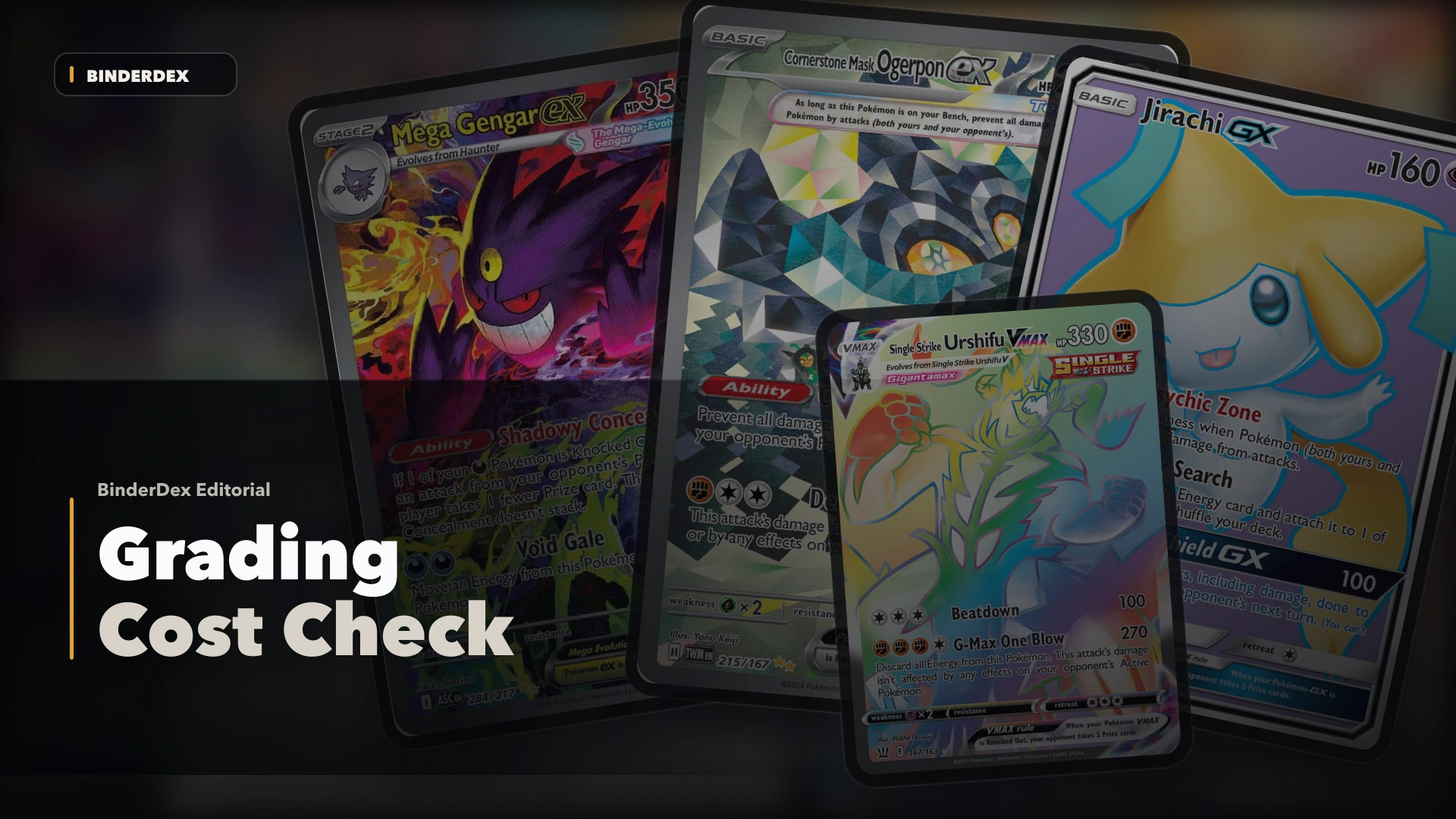
This is why the same fee can look reasonable for one card and hard to defend for another. A clean modern chase card like Mega Gengar ex can deserve a grading-cost review because the raw price, likely grade range, and graded spread may have room for the service fee and shipping. A worn common usually runs out of room before the submission is packed. A sentimental card can still make sense, but then the reason is preservation or display, not market math.

High-value cards can make grading tempting, but the raw card, condition ceiling, and graded spread all need to support the decision.
Price and chart data update with BinderDex · Last refreshed Oct 11, 2026. Editorial commentary reflects the article's published snapshot.
Add every cost line
Treat the submission like a round trip, not a checkout line. The grading fee is one line. Shipping to the grading company, return shipping, insurance, sleeves or semi-rigid holders, possible membership fees, declared value tier changes, and the opportunity cost of waiting all belong in the same note. If the card may later be sold, also read the shipping route before you submit: how to ship Pokemon cards safely when selling online.
Turnaround matters too. A card tied up in grading cannot be sold, traded, or enjoyed in the binder during that window. That may be fine for your goal, but it is part of the decision.
Think of the real number as landed grading cost: everything paid to get the card graded and back in your hands. The base service fee is easy to quote. The landed cost is the number the card has to carry.
| Cost line | Why it matters | Check first | Watch out for |
|---|---|---|---|
| Grading fee | Main service cost. | Company and service level. | Comparing base fees without declared value tiers. |
| Shipping and insurance | Protects the card in transit. | Card value and risk tolerance. | Underinsuring a card you cannot easily replace. |
| Supplies | Keeps the card safe for submission. | Sleeves, holders, packaging. | Damaging the card while preparing it. |
| Time | Card is unavailable during grading. | Turnaround and your reason. | Paying for speed when the decision is not urgent. |
| Grade risk | The card may miss the needed grade. | Condition ceiling and comparable slabs. | Assuming PSA 10, CGC 10, BGS black label, or TAG 10. |
For value context, do not let one app number carry the whole decision. Use how to check Pokemon card value for the exact-card value workflow and how to price Pokemon cards without guessing when you need to decide which price source fits raw, graded, or sold-history context.
A useful worksheet has three card values on it: raw, likely graded, and one grade lower. Put the landed grading cost next to both graded outcomes. If the lower outcome no longer beats the raw route for your goal, the card needs more condition proof or more time in a watchlist.
| Example | Fee anchor checked May 28, 2026 | Landed-cost pencil math | Wait signal |
|---|---|---|---|
| One modern chase card by itself | PSA Value $32.99 if available, or CGC Economy $18, before shipping and tier rules. | Do not spread postage across cards that are not in the box. Write service fee + outbound postage + return shipping + insurance + supplies beside the raw comp and the likely slab comp. | If the one-grade-lower slab sits near raw after the full round trip, the decision is leaning too hard on a top grade. |
| Patient batch | CGC Bulk showed $15 with a 25-card minimum; PSA Value Bulk showed $24.99 with membership and a 50-card minimum while Value services carried a pause notice. | Shared shipping can lower the per-card shipping line, but every filler card still carries its own grading fee. Count only cards you would be willing to grade without the minimum. | If the batch looks good only because weak cards are averaged into the postage math, the grade risk is being hidden. |
| Faster high-value route | PSA Regular and Express showed $79.99 and $149; TAG Priority showed $149; Beckett roadshow Express and Priority showed $85 and $130. | Use the declared value, speed tier, shipping, and insurance the card actually requires. Then write down what changes if the card returns faster. | If one grade lower makes the route break even or worse, paying for speed makes the weak point larger. |
Compare likely grade outcomes
The useful comparison is not "raw versus perfect slab." It is raw value, likely slab value, and one-grade-lower slab value after total cost.
If the card needs a top grade to make sense, inspect harder. A small surface dent, edge nick, whitening spot, or centering issue can change the expected outcome. When the realistic grade is uncertain, use a watchlist instead of forcing a submission.
For a card like Mega Gengar ex, write the math as a range instead of a wish. In the June 4, 2026 BinderDex production snapshot, Mega Gengar ex from Ascended Heroes showed Collectr NM holo at $1,360.59 and TCGplayer NM holo at $1,316.45. Those rows make the grading fee look small, but they do not remove condition risk. If angled light shows a print line, pressure mark, or back-edge whitening, the route still needs one-grade-lower math before a submission makes sense.
- The card is already valuable raw: fees are less likely to overwhelm the decision.
- Condition is unusually clean: the grade ceiling supports the route.
- The slab has a purpose: sale trust, long-term protection, set goal, or personal display.
- The downside is acceptable: a lower grade would still make sense for you.
Low, mid, and high cost scenarios
These examples are not fee quotes. They are decision shapes collectors can use after checking current service pages, shipping pages, and insurance needs.
Run the same one-grade-downside check in each scenario. A cheaper service tier helps only when the card still makes sense after the grade you do not want.
| Scenario | What is included | Collector read | Main risk |
|---|---|---|---|
| Low-cost group submission | Lower service tier, shared shipping, basic supplies, patient turnaround. | Best when you already have enough real candidates to share the trip and a one-grade miss would still be acceptable. | Membership rules, minimum counts, declared value limits, and group-submission handling can change the true cost. |
| Mid-cost individual submission | Standard service fee, tracked outbound shipping, return shipping, insurance, sleeves, semi-rigid holders, and a realistic wait. | Fits a stronger card where raw value and likely graded spread can absorb more than the listed grading fee. | The comparison can drift toward a PSA 10 or equivalent top outcome while the card is really a 9-or-lower candidate. |
| High-cost fast or high-value submission | Faster service tier, higher declared value, stronger insurance, careful packaging, and a tighter timeline. | Makes sense when timing, value, or sale route genuinely needs speed or higher coverage. | Paying for speed can turn a marginal grading idea into a worse collector decision. |
A group submission can be wrong when the batch is padded, and a fast route can be right when speed or coverage genuinely matters. The route depends on the exact card, condition confidence, and what changes if the card comes back one grade lower than hoped.
Know when grading does not help
Grading is not a universal upgrade. Some cards are better raw because the grade premium is small, the card has obvious condition issues, or the collector goal is binder enjoyment.
A $35 raw card with a possible $110 top-grade comp can still be a poor candidate if the likely 9-level comp is $40 and the landed grading cost is $60. The top-grade spread looks exciting until the one-grade-downside case is written next to it.
That is the cheap-fee trap. A lower service fee can make a bad candidate look less bad, but it does not fix weak condition, thin graded comps, slow turnaround, or a card that only works as a perfect slab.
A higher-value card can have the same problem. If a visible dent or pressure mark makes the likely grade range too wide, the card may belong in a BinderDex note with fresh photos instead of a submission cart.
A sentimental card can be worth grading even without resale math, but that is a different decision. Name it honestly. If the reason is personal preservation, do not pretend the submission has to be market math.
The selling route changes this too. If the card is headed to eBay, grading may reduce authenticity questions and make the listing easier to compare. If the card is staying in your collection, a raw copy in a clean binder slot may be the better answer. If the card is a duplicate you barely care about, the simplest move may be to hold it raw and watch the market instead.
Choose the company after the reason
Pick the grading company after you know why the card is being graded. Resale liquidity, registry goals, label preference, turnaround, error-card handling, and grading standards can all point to different choices.
Do not start with a company logo and work backward. Start with the card's job.
How BinderDex fits
BinderDex helps before the card leaves your hands. Use Explore for exact-card context, Portfolio for owned-card notes, and Watchlist for cards where the grading decision is not ready.
Record the reason you are considering grading. If that reason still makes sense after cost, time, and grade risk, the decision is cleaner.
For the cost math, keep a short note on the card: raw value checked, price source used, expected grade range, service tier, shipping estimate, and the route after return. Then compare it with PSA 10 vs PSA 9 before you submit. If one grade drop breaks the decision, the card probably needs more inspection first.
The clean route: grade only after the landed cost, realistic grade range, and slab purpose all fit the same answer. If the card needs the cheapest fee and the best grade to work, hold it raw.
FAQ
What is the real cost to grade one Pokemon card?
The real cost is the service fee plus shipping both ways, insurance, supplies, membership or minimum-submission requirements if they apply, declared value tier effects, and the value of the time the card is unavailable. The visible fee is only the starting line.
Should I grade a card if the fee is less than the expected PSA 10 premium?
Not by itself. Compare raw value against realistic outcomes, including the grade you expect and one grade lower. If the decision falls apart below the best possible grade, it needs unusually strong condition evidence.
Are grading fees current?
The examples in this article were checked on May 28, 2026, but grading companies can change fees, tiers, minimums, insurance limits, availability, and turnaround language. Verify current official pages before submitting.
Does shipping matter for grading math?
Yes. Shipping and insurance can change the decision, especially for single-card submissions. A card that looks reasonable against the base fee may look weaker after tracked shipping, return shipping, and coverage are included.
What to watch next
- Read How To Grade Pokemon Cards before submitting a card.
- Read PSA vs CGC vs BGS vs TAG when choosing the company matters.
- Read PSA 10 vs PSA 9 when the premium depends on one grade.
Compare the submission route
Read GameStop PSA grading: what collectors should check before treating a convenient drop-off route as equivalent to every direct submission option.
Know exactly what is in your collection.
Download BinderDex on iPhone or Android to track exact printings, organize your binders, and follow card and sealed product values in one place.
Prefer mobile?