Three Cards for One: How to Compare a Pokémon Card Trade
Count the cards, then compare the exact copies.
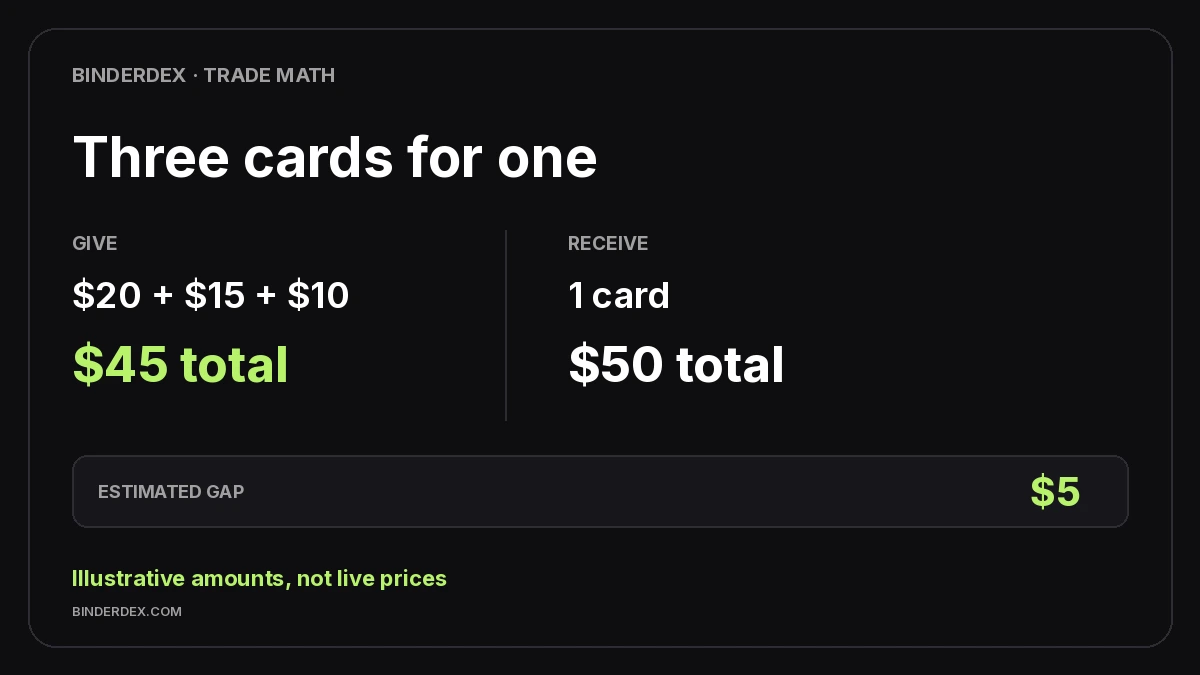
A three-for-one Pokémon trade is worth checking one card at a time. Match the exact printings, count every copy, and compare both sides on the same price basis. Add any cash separately. The number of cards tells you how many cards will change hands; it does not tell you which bundle carries more estimated value.
Start with the cards on the table. A clean total can hide a wrong version, an unchecked quantity or a condition assumption neither collector agreed to.
- Match set, collector number and finish.
- Count duplicates and cash on both sides.
- Use a consistent source and currency.
- Inspect the physical copies.
- Treat the result as a market-value check, then decide whether the trade fits your collection.
Give every card an exact identity
Write down the card name, set, collector number and finish before adding a card to a bundle. The character name alone is too broad. Similar artwork can belong to another printing, and a regular finish can share its number with a parallel foil.
For a concrete identity check, Mega Darkrai ex 120/084, Mega Chandelure ex 115/084 and Misty’s Vitality 111/084 are separate Pitch Black entries. Keep the number attached to the name when you search, compare or record a copy. These examples identify cards; they are not price quotes.
Then choose a price basis. Raw, graded, damaged and near-mint references describe different markets. If one side uses a raw near-mint estimate while the other uses a graded sale, matching totals will not make the comparison consistent. See how to choose a price basis.
Three cards against one: the first comparison
These amounts are invented for arithmetic. They are not current prices for the cards above or a suggested offer.
On mobile, swipe the table to compare both totals.
| Side | Cards | Cash | Total |
|---|---|---|---|
| Give | Card A: $20; Card B: $15; Card C: $10 | $0 | $45 |
| Receive | Card D: $50 | $0 | $50 |
The three-card bundle totals $45. The one-card side totals $50. The estimated gap is $5, despite the first side having more cards.
A collector can still prefer the three-card bundle. They might want those characters or need those exact entries for a binder. That preference is useful information, but it should be a deliberate choice rather than an arithmetic surprise.
Repeat the comparison if an identity, quantity or agreed price basis changes. One extra copy of a $10 card changes the first bundle to $55. A quantity mistake can reverse the result without any market movement.
Where the cash belongs
Keep cash on the side of the person giving it. In the same example, adding $5 to the $45 bundle brings that side to $50. Both sides then carry the same illustrative total.
Do not add the cash to both sides or subtract it twice. A short written record helps: “Cards A, B and C plus $5 for Card D.” Both collectors should be able to read that sentence and describe the same exchange.
If the totals already match, cash is not automatically needed. If they differ, the gap is a starting point for discussion, not a rule that forces either collector to accept.
Use the calculator, then inspect the assumptions
Open the Pokémon trade calculator. Add the exact cards to the Give and Receive sides, set quantities, and enter any cash on the correct side. Check every search match before trusting the total.
The calculator starts with available values from matched card records. You can edit a row’s market value, including to reproduce the illustrative arithmetic here. An edited amount is your input, not a verified quote. Keep a note of its source and date. An entry without a usable value leaves the comparison incomplete.
Matched-card defaults use raw near-mint references. The tool does not inspect the cards in front of you or grade their condition. A crease, dent or worn edge can make that estimate unsuitable for a particular copy. Pause and establish an agreed condition basis rather than treating the displayed total as a condition-adjusted offer.
The result labels are a quick summary of the numerical gap. They do not certify authenticity, measure demand for your particular copies or tell either collector what to prefer. Check the two item lists and the underlying totals even when a label looks reassuring.
- The exact printing is unresolved.
- A copy has condition concerns that the price basis does not cover.
- A card has no usable value.
- The two sides use different currencies or references.
- Either collector is unsure about the quantity or cash agreement.
A matching total still leaves a collector decision
Before agreeing, name the reason you want the incoming cards. Are they filling specific gaps, replacing duplicates or becoming the anchor of a page? That is easier to judge than whether the bundle contains more shiny cardboard.
Consider the copies you are giving up as well. Trading several cards that you already want to keep for one card you only vaguely want can be a poor fit even when the estimates are equal. A calculator is helpful here because it separates the visible value gap from that personal decision.
For an in-person exchange, inspect the front and back of each copy and confirm the agreed bundle before handing anything over. This tutorial covers comparing the bundle; a remote trade also needs a separate agreement about payment, shipping and protection.
Questions at the trade table
Is three cards for one automatically an uneven trade?
No. Compare the exact copies and totals. Either side can have the higher estimated value, and both collectors may have reasons to accept a visible gap.
Does adding cash make the trade fair?
Cash can close the numerical gap when it is added to the correct side. It does not resolve a wrong printing, uncertain condition or a bundle one collector does not want.
Can I use a near-mint estimate for a played card?
Only if both collectors understand that it is not an estimate of that played copy. Establish suitable condition evidence before making an offer from it.
What if a card has no price in the calculator?
Find a suitable reference and record its source before editing the row, or keep it unresolved. A missing value is not zero, and the full bundle cannot be compared reliably until that entry has a usable basis.
Keep the final bundle clear
Use the calculator for the ledger, the pricing guide for the evidence behind a number, and Explore when an exact match is still unclear. The clean route is to identify the cards, inspect the copies, agree on the basis and write down the exchange both people intend.
Know exactly what is in your collection.
Download BinderDex on iPhone or Android to track exact printings, organize your binders, and follow card and sealed product values in one place.
Prefer mobile?