Where To Check Pokemon Card Prices Before You Decide
Use card-specific price context, not broad search results.
The best place to check Pokemon card prices depends on the question in front of you. A card page, a marketplace listing, a sold listing, a price-history chart, and a grading-company page are not interchangeable.
Start by identifying the exact card. Then choose the source that answers the next decision: rough market context, completed-sale evidence, historical movement, raw-versus-graded comparison, or a saved BinderDex note.
A quick lookup can use one number. A card that affects a binder route, trade context, listing route, grading review, or collection estimate needs a short evidence trail.
- Start with exact card identity: set, number, rarity, language, and variant.
- Use marketplace pages for current options, but keep active asks separate from paid examples.
- Use completed sales when the next step involves a real transaction or trade discussion.
- Use price history to spot movement, not to force a single value.
- Save the card note in BinderDex so the source trail stays attached to the decision.
Start with exact-card lookup
Start with the card, not the search result. Confirm set, number, rarity, language, finish, and variant before trusting a price.
The first note should read like card evidence, not a number: "Pikachu ex, Ascended Heroes, 276/217, English, raw, front clean, back edge needs another photo."
That one line blocks the common mistakes. A different Pikachu ex, a different collector number, a Japanese copy, a sealed product, and a PSA 10 slab all belong in separate comparison lanes.
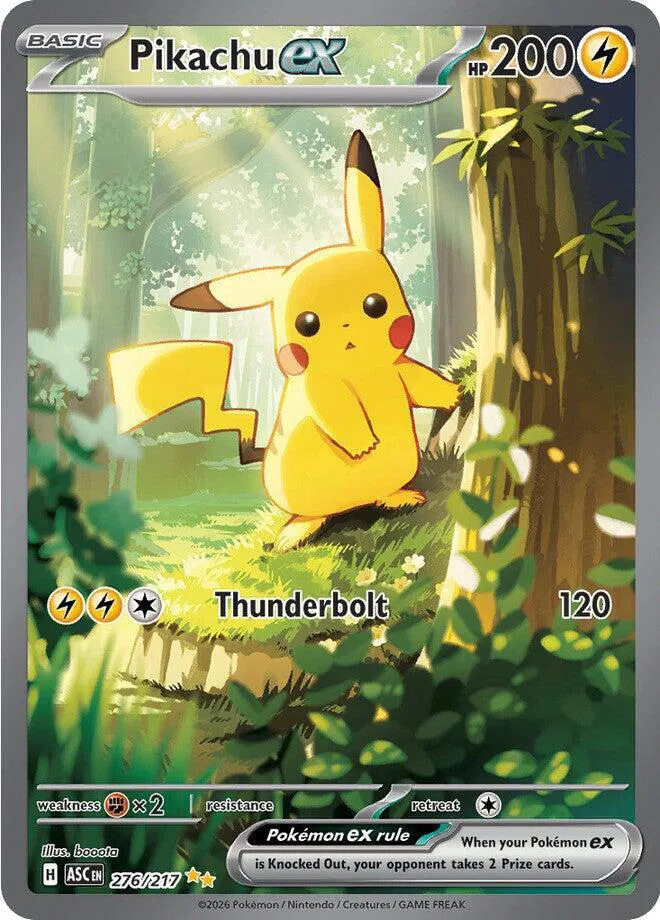
Use exact-card lookup before checking price sources. The same Pokemon name can lead to very different markets.
Use marketplaces carefully
Marketplaces are useful once you know what job each source is doing.
TCGplayer-style pages are strongest for current English singles context when the product and condition lane are clear. eBay is stronger when photos, slabs, sealed items, odd variants, or completed-sale screenshots matter.
PriceCharting can add longer raw and graded history, but it may blend sources in a way that needs checking. PSA, CGC, BGS, or TAG pages answer slab-specific questions, not raw-card value by themselves.
The danger is flattening those jobs into one answer. A raw near-mint card, a played binder copy, and a PSA 10 slab should not share the same comparison note.
A practical comparison starts with BinderDex or another exact-card page. Then check TCGplayer for product and condition context, eBay sold listings for paid examples, PriceCharting for movement, and grading-company pages only when slab context matters.
If the card came from a fast scan, use Pokemon card scanner apps compared to understand where app lookup helps and where condition still needs human review.
| Source route | Best when | Check first | Watch out for |
|---|---|---|---|
| BinderDex card page | You need exact-card identity and a saved decision note. | Set, number, variant, price context, watch reason. | Treating a chart move as an automatic action. |
| TCGplayer | You need current singles context for a known product. | Same product, language, condition, and seller notes. | Confusing market context with your exact copy. |
| eBay sold listings | You need completed-sale evidence or photo-heavy comps. | Sold status, date, photos, condition, shipping. | Mixing active listings, wrong variants, and slabs. |
| PriceCharting | You need longer raw or graded movement context. | Source mix, update timing, and raw/graded lane. | Treating blended history as exact value. |
| Grading company pages | You need grade standards or slab population context. | Company, grade, cert confidence, eligibility. | Letting population alone decide the card's route. |
Use sold listings for decisions
If a card may enter a listing, trade, or grading-review route, sold context is stronger than active asking price.
The useful workflow is a small comp screen. Keep each candidate sale only if the set, number, language, finish, raw/graded lane, condition, and date match the card well enough.
Example note: "Three matching raw English sales cluster near the same range; two active asks are much higher; one sold slab excluded; one Japanese copy excluded."
That note is more useful than copying the highest number. It explains what counted, what did not count, and why the card still needs watchlist review if the evidence is thin.
Use price history for movement
Price history answers a different question: is the card calm, rising, cooling, or noisy?
It does not prove that every move deserves action. A watchlist can hold interest without turning every spike into a decision.
Use short movement notes. "Low-volume jump, no matching sold examples yet" is clearer than "price is up." "Repeated raw sales, same condition lane" is stronger than one loud datapoint.
- Repeated direction: multiple checks point the same way.
- Volume context: one sale is weaker than repeated evidence.
- Set context: current releases can move differently from older cards.
- Condition split: raw and graded charts can tell different stories.
Separate raw and graded context
Raw prices and graded prices are not the same comparison lane. A PSA 10 result may explain why condition matters, but it does not value the raw card in your hand.
When a card becomes a grading-review candidate, compare raw comps, likely grade range, grading cost, shipping, insurance, timing, and the reason a slab would matter to the collection.
If the only useful outcome is a perfect grade, write that in the note. The evidence should get more cautious, not more confident.
A simple source stack example
Imagine a collector checking a clean modern special art before deciding whether it belongs in a watchlist or trade conversation.
BinderDex answers the first question: is this the right set, number, rarity, language, and finish? TCGplayer can show current singles context for that exact lane. eBay sold listings can confirm whether paid examples match the same condition.
PriceCharting can show whether the longer trend is calm or noisy. PSA context only matters if the card might become a slab-specific review.
The stack should change when the card changes. A low-pressure binder card may only need identity and a rough range. A damaged vintage holo needs condition-specific photos and sold comps. A PSA 10 comparison needs company, grade, cert confidence, and population context separated from raw copies.
Write the source note in plain language: "exact card confirmed, raw near-mint lane, sold context mixed, watch again later." That note is better than a confident number with no trail.
The useful habit is to name the source's job before you use it. Once the job is clear, disagreement between sources becomes information instead of confusion.
How BinderDex fits
BinderDex is where price context becomes a collector record. Use Explore to find the exact card, Portfolio for cards you own, and Watchlist for cards you want to observe.
That keeps prices attached to decisions. It also makes it easier to ignore numbers that are interesting but not relevant to your binder.
A useful BinderDex note might say: "set-completion target, raw only, verify sold comps next review." Another might say: "owned copy, back whitening, do not compare to PSA 10 chart."
For a full collection estimate, use this source stack inside the broader sorting process from how to find out what your Pokemon card collection is worth. Single-card price checks and collection estimates solve related but different problems.
FAQ
What is the best free place to check Pokemon card prices?
The best free starting point is exact-card lookup paired with marketplace context. Use the card page to confirm identity, then compare marketplace or sold-listing data for that same version and condition lane.
Are active listings or sold listings better?
Sold listings are usually stronger for decisions because they show completed transactions. Active listings can still help you understand supply and seller expectations, but they are not proof of value.
Where should I check graded Pokemon card prices?
Use graded-card sources only after the company and grade are clear. PSA 10, PSA 9, CGC, BGS, TAG, and raw copies are separate comparison lanes.
Why do Pokemon card price sources disagree?
Sources disagree because they mix timing, condition, platform fees, shipping, grading company, sales volume, and version matching differently. When sources conflict, document the reason instead of forcing one exact number.
What to watch next
- Read How To Price Pokemon Cards Without Guessing when you need a defensible range.
- Read How To Check Pokemon Card Value when the card version or condition is uncertain.
- Read How To Track Pokemon Card Prices Without Chasing Every Spike when price movement is the main question.
Keep watchlist moves separate from your binder.
Download BinderDex on iPhone to track exact cards, organize portfolio decisions, and avoid turning every short-term price move into a buy.