Pokemon Card Collection Tracker: What to Record First
A collection total is only useful when every card underneath it is the right card.
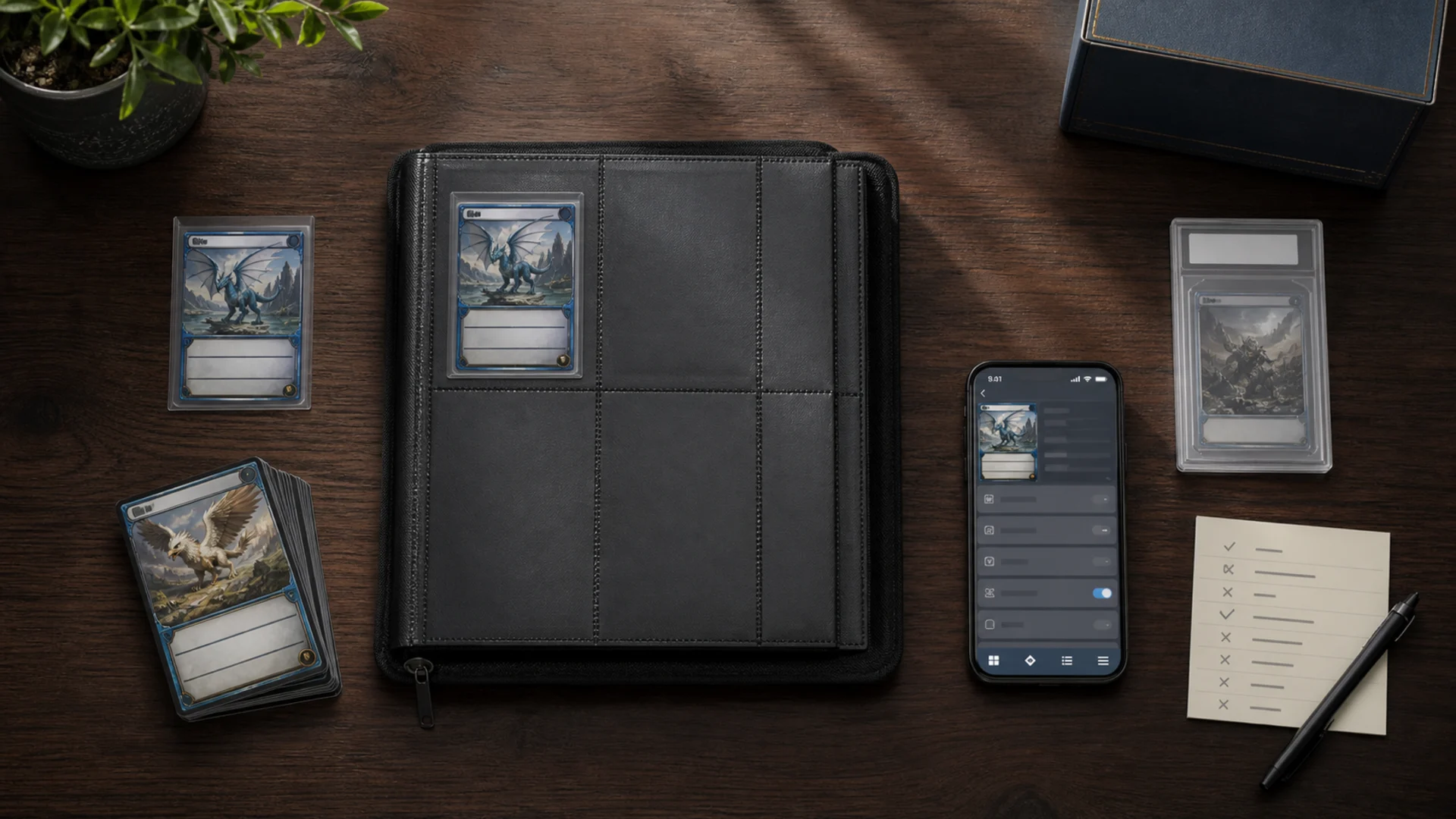
A useful Pokemon card collection tracker should tell you exactly what you own before it tells you what the collection is worth.
For each copy, record the set, collector number, variant or finish, language, quantity, raw condition or grading details, ownership state, and a note that helps you find it again. Let price attach to that record afterward, with a source and update date.
That order matters. If a Base Set Pikachu and its Legendary Collection reprint are merged because the artwork looks familiar, a perfectly fresh price still produces the wrong collection total.
- Exact printing: card name, set, and full collector number
- Version: normal, reverse holo, holo, stamped, first edition, promo, or another verified variant
- Copy details: language, quantity, and raw condition or grader, grade, and certification number
- Ownership state: owned, wanted, for trade, listed, sold, or pending review
- Retrieval note: binder, box, slab case, deck, or another location you can understand later
- Price context: source, condition lane, and the date the value was checked
A collection tracker is an inventory first
A tracker has two different jobs:
- Preserve the facts about each copy.
- Use those facts to show useful totals, changes, gaps, and set progress.
The first job has to survive when the market changes. Your Base Set Pikachu remains Base Set Pikachu whether its displayed value rises or falls. It is still the same card when a price temporarily disappears, and it does not become Near Mint because a marketplace has a convenient Near Mint price.
Treat the portfolio total as an output. The inventory is the evidence underneath it.
This is also where a collection tracker differs from a physical organization system. Our guide to organizing Pokemon cards covers intake trays, binder sections, duplicate piles, and storage locations. This guide owns the digital record: what to save so your chosen tool still describes the shelf accurately.
Record these fields before price
You do not need a museum catalog for every common card. You do need enough information to keep exact printing and condition attached to the right ownership state.
| Field | What to record | What goes wrong when it is missing |
|---|---|---|
| Card identity | Name, set, full collector number | Same-art reprints collapse into one record |
| Variant | Finish, stamp, edition, promo treatment | Holo and reverse-holo copies inherit the same value |
| Language | English, Japanese, or the actual language | Different releases and markets get mixed |
| Quantity | Number of copies in this exact condition and variant | One clean copy hides several played duplicates |
| Raw condition | A consistent condition bucket plus notes for meaningful flaws | The tracker prices every raw copy as Near Mint |
| Grading details | Company, grade, and certification number | A slab is treated as a generic graded card |
| Product state | Raw card, graded card, or sealed product | Unlike items get added to the same comparison |
| Ownership state | Owned, wanted, for trade, listed, sold, or review | A wish list inflates the owned collection |
| Location | Binder, page, box, deck, slab case, or shelf code | The record is right, but the copy cannot be found |
| Price context | Source, condition or grade, and checked date | An old or mismatched number looks current |
The first three fields identify the printing. Quantity and condition describe the copies. Ownership and location explain what they are doing in your collection. Only then is a price row ready to join the record.
Exact printing comes before card name
Card name is a search starting point, not a unique identifier. Pikachu has appeared across eras, sets, promos, and languages. It also has different finishes and reprints. Artwork can repeat. Collector numbers can repeat across different sets. A number without a set is not enough, and a set without a number still leaves room for variants.
Use this sequence:
- Read the set symbol or modern set code.
- Read the complete collector number, including the number after the slash.
- Match the card name inside that set.
- Confirm the finish and language, then check for a stamp or edition mark.
- Put uncertain copies into a review queue instead of choosing the closest result.
The Pokemon set-symbol guide shows where set marks and codes move across eras. The holo versus reverse-holo guide handles the finish check when two cards share a number.
Worked example: two familiar Pikachu cards
These two cards make the database problem visible. They share a character and a familiar illustration, but they belong to separate sets and separate records.
Set and collector number keep a familiar reprint from inheriting the wrong identity.
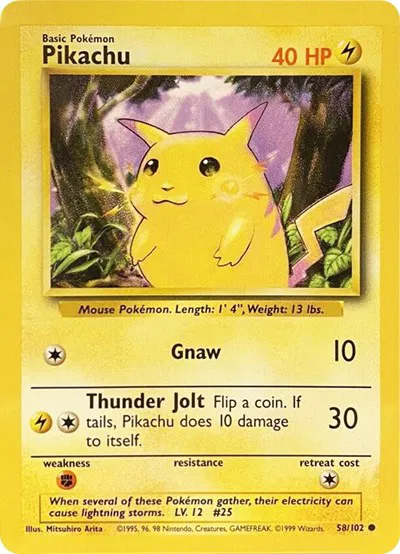
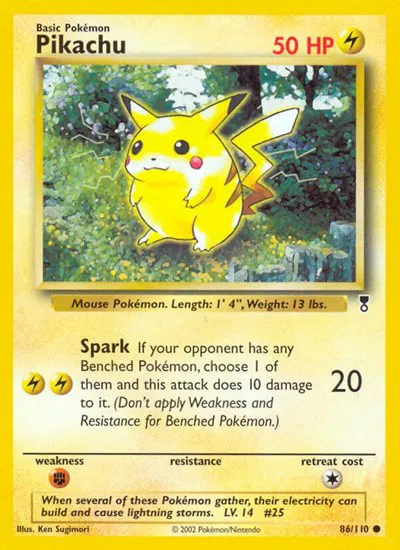
Suppose you own:
- one raw Base Set Pikachu
58/102in Lightly Played condition; - two raw Legendary Collection Pikachu
86, one Near Mint and one Moderately Played; - one graded copy of the Base Set printing.
That is not one row with quantity four. It is at least four copy states attached to two exact card identities. The raw condition groups should remain separate, and the slab needs its grader, grade, and certification number.
If you merge those copies, the tracker cannot answer basic questions: Which copy is in the slab case? Which duplicate is for trade? Which condition should be priced? Did you finish the Legendary Collection binder slot?
Keep each product state separate
Raw condition and numerical grade are different systems. A raw card described as Near Mint is not a hypothetical PSA 9 or PSA 10. It is an ungraded copy in a condition bucket.
For a raw card, save a consistent condition label and a short note for defects that may affect the next decision. “LP, whitening on two back corners” is more useful than a false-precision score you cannot defend.
For a graded card, record:
- grading company;
- numerical grade and any qualifier;
- certification number;
- label or service detail when it materially distinguishes the slab;
- the physical slab location.
For a sealed item, use the exact product rather than a set-level placeholder. An Elite Trainer Box, Pokemon Center Elite Trainer Box, Booster Bundle, and booster box can share a set name while containing different products. Quantity and condition still matter, but pack count, product edition, and seal damage replace card finish as the important version details.
When you later check value, compare raw to the matching raw condition, the slab to the matching grader and grade, and the sealed product to the exact sealed product. The Pokemon card pricing guide covers that second-stage workflow.
Separate what you own from what you want
The cleanest collection tracker does not use one list for every intention.
An owned card belongs in inventory. A wanted card belongs on a watchlist or want list. A copy offered in a trade is still owned, but it needs a for-trade state. A sold card should leave the active quantity only when the sale is complete.
| State | Count in owned quantity? | Useful next question |
|---|---|---|
| Owned | Yes | Where is the copy and what condition is it in? |
| Wanted | No | Which exact printing or acceptable alternatives are wanted? |
| For trade | Yes | Which copy is available, and is the condition note current? |
| Listed | Yes, until the transaction completes | Is one copy reserved for an active order? |
| Sold or traded away | No | Was the quantity reduced and the transaction recorded? |
| Pending review | Usually yes, without confident price | What identity or condition fact still needs checking? |
BinderDex separates these jobs. Add owned cards and sealed products to Portfolio. Add cards you are considering or still need to Watchlist. Mark a portfolio copy for trade when it remains yours but is available to leave.
That split prevents a common mistake: adding a chase card to the portfolio because you want to watch its price, then forgetting that the collection total now includes a card you do not own.
Use quantity only for truly matching copies
Quantity is convenient when every copy in the row has the same identity, variant, language, condition, ownership state, and location rules.
Three Near Mint English reverse-holo copies can usually share a quantity. Two Near Mint copies and one damaged copy should not. A trade copy stored in a deck box may deserve a separate note even if its card facts match the binder copy.
Use the smallest number of rows that still preserves the next decision. If one row cannot answer “which copy am I selling?” or “which condition am I pricing?”, split it.
Location notes do not need to be elaborate. A code such as B03-P12-S04 can mean binder 3, page 12, slot 4. TRADES-A can be enough for a duplicate box. The label only works if the same code appears on the physical container.
Price needs a source and a date
A tracker that shows one large total can feel complete even when the number underneath each card is stale or mapped to the wrong version.
For any value used in a decision, preserve three pieces of context:
- source or marketplace;
- matching raw condition or graded/sealed state;
- update date.
Do not silently replace missing condition data with a Near Mint price. Do not attach a graded sale to a raw copy. Do not interpret a marketplace listing as a completed sale.
For routine collection monitoring, an automated estimate can be a useful signal. Before a sale or trade, an insurance schedule, or a grading decision, inspect the exact card and current evidence again. The guides to checking Pokemon card value and finding out what a collection is worth own those deeper valuation passes.
Test the exit before choosing a tracker
The best tracker is not only the one that makes the first import easy. It should also let you correct records, separate copy states, and retrieve your data later.
Before committing hundreds of cards, create five difficult records:
- two same-art printings from different sets;
- a normal and reverse-holo copy with the same collector number;
- raw copies in two conditions;
- a graded copy with certification details;
- a sealed product plus a wanted card you do not own.
Then export the collection. Check whether the file preserves the distinctions you entered. An export that flattens variants and conditions or drops ownership states is a backup of the total, not a backup of the collection.
Current official product documentation shows why this test matters. TCGplayer tells app users to verify amount, set, foiling, condition, language, and other scan details before exporting a list. PriceCharting documents grade or condition plus quantity, photos, notes, and value history. Collectr describes tracking for raw cards, slabs, sealed products, and other collectibles, while its export feature is listed under PRO. Dex documents an iOS CSV export for Dex+ and says collection import is not currently supported. Features and plan limits change, so verify the current product page before migrating a large inventory.
BinderDex currently tracks raw cards, graded cards, and sealed products separately in Portfolio, including quantity, condition or grade details, for-trade state, and notes. Its mobile portfolio export preserves card or product type, set, card number, condition or grade, quantity, value, date added, trade state, and notes in CSV. The export is a portability tool, not permission to skip an identity check on the way in.
A practical BinderDex tracking loop
Use this loop after a pack opening, purchase, trade, or grading return.
- Identify: Find the exact set and collector number, then confirm finish and language.
- Inspect: Assign a raw condition or enter the grader, grade, and certification details.
- Count: Group only copies that match on identity, variant, condition, ownership state, and location rules.
- Route: Add owned items to Portfolio, wanted items to Watchlist, and unresolved items to review.
- Locate: Add a binder, box, deck, slab case, or shelf note when retrieval matters.
- Value: Let the matching market row attach to the verified record; date any manual comparison.
- Reconcile: After any sale, trade, or physical move, update the digital quantity and location together.
Do not make the first session a census of every card you have ever owned. Start with one binder or one intake stack. Finish the records completely, test search and export, and then expand.
Common collection tracker mistakes
Choosing the first visual match
A photo or scan result is a candidate. Confirm the set and number, then the finish and language, before saving it. The Pokemon card scanner comparison explains why a scanner should speed up inspection rather than replace it.
Recording every raw card as Near Mint
This inflates totals and makes later selling work harder. Use conservative, repeatable condition buckets. Add a note when a flaw is important enough to change the route.
Mixing a want list into inventory
Wanted cards should not count toward portfolio value or set completion. Keep the desired printing explicit so a cheaper reprint does not accidentally close the gap.
Deleting sold cards before reconciling quantity
If a row has three copies and one sells, reduce the exact copy group to two. Do not delete the entire identity or leave the sold copy in the active total.
Trusting the total without spot checks
Each month, sample a mix of high-value records, slabs, sealed products, and duplicates. Match them to the physical copies. A small reconciliation pass catches systematic errors before they spread across the whole collection.
FAQ
What is the best way to track a Pokemon card collection?
Use a tracker that preserves exact set and collector number, variant, language, condition or grade, quantity, ownership state, and exportable notes. Test it with difficult duplicate and variant cases before entering the full collection.
Should I use a spreadsheet or a Pokemon card collection app?
Use the tool you will keep current. A spreadsheet offers flexible fields and easy inspection. An app can provide card matching, images, set progress, and automated price context. Either can fail if exact printings and copy states are merged.
Do I need to track every common Pokemon card?
No. Track to the level needed for your goal. A set collector may record every checklist position. A value-focused collector may inventory protected cards and sealed products first. Keep one consistent rule so missing records are intentional.
Should raw cards and graded cards be separate?
Yes. Raw condition is not a numerical grade, and graded prices depend on the grading company and grade. Save certification details for slabs and price each state against matching evidence.
How often should I update my Pokemon card tracker?
Update quantities and ownership after every transaction. Reconcile locations when cards move. Refresh price context when a decision depends on it, rather than manually repricing every card every day.
Can a scanner build an accurate collection automatically?
It can accelerate the first match. You still need to verify the set, collector number, variant, language and quantity, then condition. A fast wrong match is still a wrong inventory record.
What to watch next
- Use How to Organize Pokemon Cards to make physical storage and intake agree with the tracker.
- Use Pokemon Set Symbols Explained when the exact printing is unclear.
- Use How to Price Pokemon Cards Without Guessing after identity and condition are settled.
- Use the Pokemon Card Collector Confidence Guide when a copy needs identity, condition, authenticity, or next-action review.
Know exactly what is in your collection.
Download BinderDex on iPhone or Android to track exact printings, organize your binders, and follow card and sealed product values in one place.
Prefer mobile?