Pokemon Card Databases: How to Find the Exact Printing
Turn a broad name search into one catalog record with the clues printed on the card.
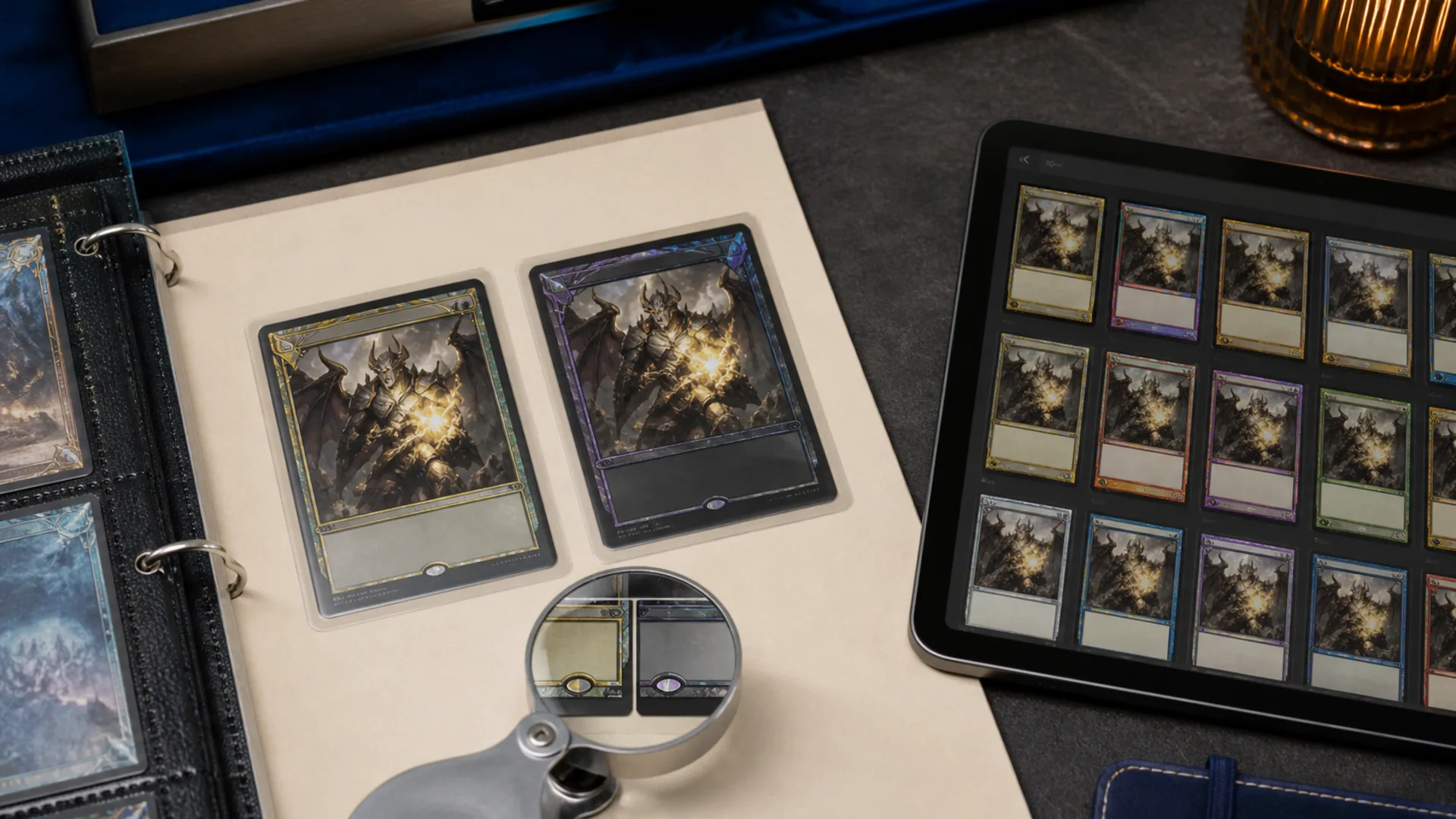
A Pokemon card database can find the right record only after you give it the clues printed on the card. Start with the expansion mark or set code and the full collector number. Then confirm finish, language, and any promo or edition mark. Card name alone opens a results page; the printed combination closes it.
That last check keeps a familiar illustration from becoming the wrong entry in a binder, spreadsheet, or collection app. A database match identifies a catalog record. It does not authenticate the physical card, grade its condition, or guarantee a market price.
- Set mark or code: Record the expansion symbol or short code exactly as it appears.
- Full collector number: Keep both sides of the slash, including a number above the printed denominator.
- Name: Use the printed spelling and suffix, such as
ex. - Finish or variant: Separate non-holo, holo, reverse holo, textured, stamped, and other distinct treatments.
- Language: Keep the language with the record when the card is not English.
- Promo or edition mark: Treat a promo code, First Edition mark, or event stamp as an identity clue.
Move an uncertain field into a review pile. One unresolved clue is better than one confident wrong record.
Read the lower edge before you search
The lower edge gives a database enough structure to narrow a name search. Take a clear photo or write the clues down before opening tabs. The symbol and number do different jobs, so preserve both.
| Printed clue | What it narrows | What it cannot prove |
|---|---|---|
| Card name | The character, Trainer, Energy, or named card family | The set, version, or artwork-specific printing |
| Expansion mark or set code | The expansion or product family | Finish, condition, language, or whether the card is authentic |
| Collector number | The position within a numbered set or promo sequence | A match by itself when a parallel finish shares the number |
| Rarity mark | The card's rarity lane within a set | The exact foil treatment or market outcome |
| Finish | A physical variant such as holo or reverse holo | Set identity when the same finish appears in several releases |
| Language | The regional printing and usable catalog lane | Whether a translation shares every English variation |
| Stamp or edition mark | A promo, event, First Edition, prerelease, or other marked version | The card's condition or physical authenticity |
The mark can move around by era and card type. Use Pokemon card set symbols explained for the full card-in-hand symbol procedure, and Pokemon card rarity symbols explained when the rarity mark needs a separate read. This article starts after those clues reach the search box.
Turn a broad search into one record
Use the official Pokemon TCG card database as an identity reference, then take the confirmed record into BinderDex search. Pokemon Support says the database's advanced search can filter by card type, Energy type, rarity, evolution, format, expansion, HP, retreat or attack fields, weakness, resistance, and illustrator. Its support guide does not list a collector-number field, so use the number as your visual confirmation rather than expecting that filter.
- Transcribe the card first. Write its name, expansion mark or code, full number, language, finish, and every stamp. Keep a question mark beside any clue you cannot read.
- Search the name. Use the official database's basic search to gather candidates. Ignore cards that fail the set or era at a glance.
- Apply the strongest official filters. Filter by expansion, rarity, card type, or illustrator when those clues are clear. The point is a short candidate list, not a forced match.
- Compare the physical card to each candidate. Check the full collector number, rarity, artwork, text layout, and printed mark. A number above the set denominator belongs in the comparison.
- Check the finish and language. Tilt the card under plain light, then compare the foil placement and language to the candidate record. Read Pokemon holo vs reverse holo cards explained if the foil surface is the remaining uncertainty.
- Open the exact BinderDex record. Browse the Pokemon catalog, open the matching set, then open the matching card. Save only after the set, number, finish, and language agree.
This sequence turns a broad result into a usable identity key. If the database still gives two plausible cards, leave both candidates open and search another printed clue. Do not choose from image resemblance alone.
Keep the record of that comparison with the card. A simple note such as Paldean Fates | 232/091 | English | SIR treatment gives you enough detail to return to the same row later. Avoid notes such as “pink Mew” or “holo Pikachu.” Those descriptions help you find a sleeve, then force you to repeat the database work when you need the exact printing again.
The collector number deserves a full read. The number before the slash identifies the card's sequence position; the number after it identifies the printed main-set count. A number above that count can point to a numbered card beyond the main set. Write leading zeroes when the card uses them, and keep a promo code in the same note when the card belongs to a promo sequence instead.
Use one source of truth for each card while you work. If a sleeve, note, or collection entry carries a different number from the record you just confirmed, pause and resolve the difference before copying the entry anywhere else. That small pause prevents a wrong candidate from spreading through a binder list, a portfolio, and a watchlist together.
Example: Mew ex needs more than a set name
Paldean Fates contains more than one Mew ex record. The two cards below share the name and set, yet 232/091 and 216/091 point to different entries. Their rarity and art treatment provide a second check; the exact card image provides a third.
One name and one set can still hold separate printings. The collector number closes the match.
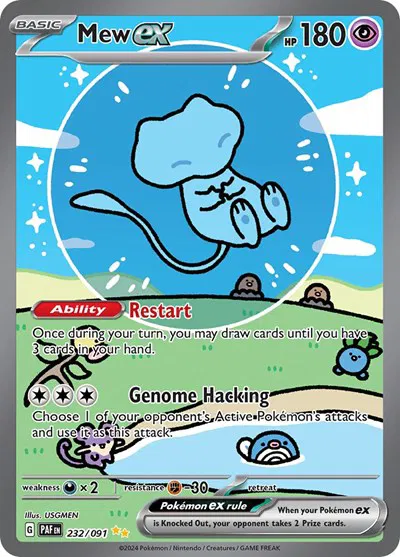
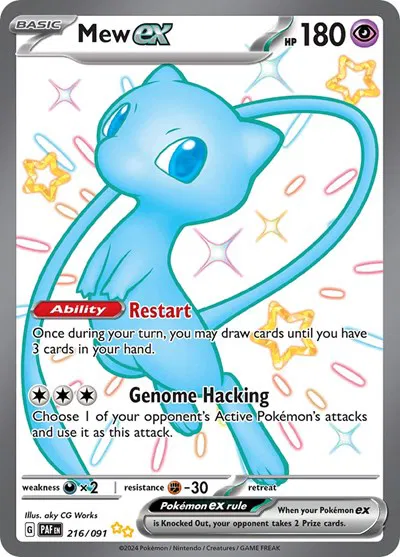
For the card in hand, read 232/091 or 216/091 before recording “Mew ex.” The Mew ex 232/091 record belongs to the card often called Bubble Mew; the deeper Bubble Mew spotlight covers its collector appeal. That story does not change the identification job. The catalog record comes first.
The two Mew entries also show why rarity alone cannot carry the lookup. A rarity label may tell you that a card occupies a premium lane, while the full number and image tell you which lane member sits in your hand. Compare the artwork's composition, the printed number, and the foil or texture treatment together. If one feature disagrees, keep searching instead of assigning the closest name match.
Example: one artwork can cross sets
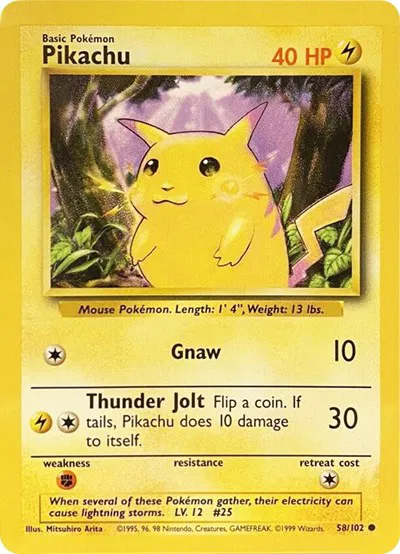
Base Set Pikachu 58/102 and Legendary Collection Pikachu 86/110 use the same central illustration. Their set treatment and full collector numbers separate the printings. The artwork is useful for finding candidates, yet the set and number own the record.
Compare the Base Set Unlimited and Legendary Collection records by set treatment and collector number, not the repeated illustration.
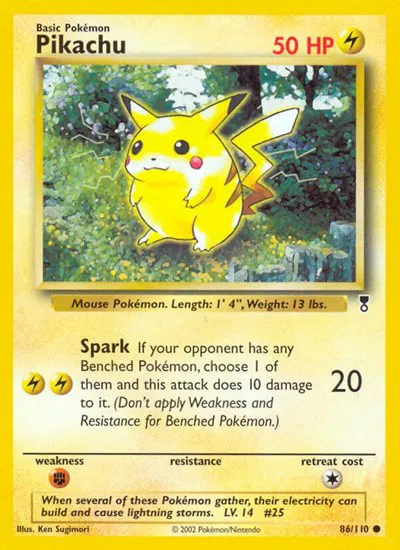
The same-art problem also explains why a scan needs review. Pokemon card scanner apps compared covers the camera workflow and its limits; a scan can create a candidate, while the printed lower edge settles the printing.
Use this same method for an old card with a familiar picture. First find both candidates from the name or image. Then place the physical lower edge beside the record: 58/102 belongs to the Base Set sequence, while 86/110 belongs to Legendary Collection. The identical artwork stops being a problem once the printed pair gives each catalog entry its own address.
Choose the database for the next job
Each database serves a different part of the workflow. Move between them as the job changes rather than asking one entry to answer identity, collection tracking, authenticity, and condition at once.
| Database | Best use after you read the card | What to keep checking |
|---|---|---|
| Official Pokemon database | Official card identity and published card fields | Full number, finish, language, and the physical card |
| BinderDex | Set and card browsing, live product records, price history, portfolio, and watchlist | The selected route still needs the exact printing |
| TCGplayer catalog | Marketplace printing, condition, and language context | Listing details, finish, and seller-provided condition |
| PriceCharting | Longer sales and graded-card context after identity | The exact raw or graded version behind the comparison |
No single database authenticates the copy in hand or replaces condition inspection. Use the record to name the card first. Then choose the data source that matches the next task.
Handle the cases that break quick searches
Some printings leave out the clue a newer card would show. Others add a clue that an ordinary set search will miss.
| Case | Database habit |
|---|---|
| Base Set with no expansion symbol | Start with 58/102, the name, card layout, and edition details. TCGplayer documents the no-symbol Base Set exception. |
| Number above the denominator | Keep the complete form, such as 232/091; it can be a numbered set card beyond the main count rather than a typo. |
| Holo versus reverse holo | Record where the foil appears and compare the parallel finish as its own row. |
| Promo or stamped card | Search the promo code, stamp, event, or edition mark with the name. Keep it outside a standard numbered-set row when the catalog does. |
| Non-English printing | Search the printed language and regional set context. Do not overwrite it with an English match that only looks similar. |
| Familiar art in a reprint | Let set and collector number outrank artwork. |
| Scanner mismatch | Treat the result as a candidate, then verify set, foil type, condition, language, and quantity as TCGplayer advises. |
The holo and reverse holo guide helps with the finish lane. If the card stock, text, color, texture, or print quality creates doubt, use how to tell if a Pokemon card is fake before letting a database record create confidence.
For a secret number, resist the temptation to “correct” the card to the denominator. 232/091 is more useful than “card 91” because the unusual first number is the clue that separates the record. For a stamped card, capture the stamp in words as well as in a photo. A stamp can distinguish a standard release from a prerelease, event, league, or product-specific version even when the name and number look familiar.
Sort a stack without corrupting the records
Work in short batches. Group the stack by obvious set or era first, then make a separate “needs review” pile for unread numbers, uncertain finishes, and cards that may be promos or another language. The review pile protects the rest of the inventory from guessed rows.
For each resolved card, open its exact BinderDex card search result and add the card to your portfolio only when the record matches. Put cards you want to revisit into your watchlist, then use the Pokemon catalog or Explore to fill missing set context. Pokemon card collection tracker and how to organize Pokemon cards extend that routine into a binder or inventory system.
Keep the unresolved cards visible. A clean collection record is more useful than a complete-looking record built from guesses.
For a large stack, give every card one of three outcomes before moving on: exact record, review pile, or duplicate of a record already checked. Record the clue that blocked the review card, such as “number rubbed off,” “foil unclear,” or “Japanese set code.” That note gives the next pass a starting point. It also keeps a later scanner result from overwriting a better physical observation.
Where the database match ends
A database record offers plausibility and identity evidence. It cannot inspect card stock, ink, layering, texture, cut, light test behavior, or the details a counterfeit can imitate poorly. It also cannot see a dent under the sleeve or turn a catalog image into a condition grade.
Use several physical signals for a fake-card review, and compare the card with a trusted reference without relying on one clue. The Pokemon card identification hub routes set, symbol, finish, and authenticity questions to their deeper guides. Keep authentication, condition, and catalog identity as separate fields in your notes.
FAQ: Pokemon card database matches
What is the best Pokemon card database?
The best Pokemon card database depends on the next job. The official Pokemon database supports official identity fields; BinderDex supports browsing and collection workflows; TCGplayer provides marketplace context; PriceCharting can provide longer sales and graded context after you confirm the printing. Use the record that matches the task, then compare the physical card.
Can I identify a Pokemon card by its number?
The collector number can narrow the card sharply when you keep the full number, set clue, name, finish, and language together. A shared number can still have parallel finishes, and promo numbering can follow a different sequence.
Why do two database entries show the same artwork?
Pokemon has reused illustrations across sets and products. The shared artwork helps find candidates. The expansion, collector number, finish, language, and mark separate the catalog records.
Does a database match prove a Pokemon card is real?
No. A match shows that the printed clues resemble a catalog record. Inspect the physical card and use multiple authenticity signals before you treat it as genuine.
What if my card has no set symbol?
Use the full collector number, card layout, edition details, language, and name. English Base Set cards are the common no-symbol exception, so 58/102 and the printing details carry more weight.
- Read and record the card name, expansion mark or code, and full collector number.
- Add the language, finish, rarity, and every promo, stamp, or edition mark.
- Search the official database by name, then filter by the clues it supports.
- Compare the card against the remaining candidates, including the full number and artwork.
- Open the matching BinderDex set and card record, then save only when the details agree.
- Put any unresolved field in a review pile before adding the card to a portfolio or watchlist.
When one record matches, search BinderDex for the exact card, browse the related Pokemon set catalog, then add it to your portfolio or watchlist. The result should be one identity key and one exact printing, not a pile of tabs.
Know exactly what is in your collection.
Download BinderDex on iPhone or Android to track exact printings, organize your binders, and follow card and sealed product values in one place.
Prefer mobile?